1. There are key moments of opportunity.
2. You need the right people.
3. Good leaders collaborate and navigate.
4. Innovation requires some trial and error. (1)
5. Innovation requires some trial and error. (2)
6. Innovation requires some trial and error. (3)
1. The Seminary started with Russ Gunsalus as Chief Operating Officer (COO) for 6 months. It wasn't a particularly attractive title. Many on the Seminary Task Force had preferred to give the head of the Seminary a dual title--to call him or her a VP internally but a President externally. It was the way Bethel in Minnesota was structured at that time... until they changed it. :-)
For one, some thought it would be confusing to outsiders for the head of the Seminary to be a "Vice President." The structure subcommittee of the Seminary Task Force (which included Ed Hoover) wanted to call the Seminary head a President because they wondered if donors and external individuals would naturally want to talk to a "VP." They might naturally think that person was the second in command.
Nevertheless, it hasn't proved to be a problem, especially if I'm introduced as the academic Dean.
Russ stuck with COO for his brief, six month stint as leader. Then when Wayne Schmidt came to be head of the Seminary in its second semester, he went with the title of "Vice President for Wesley Seminary." That kept with the theme at that time of IWU being a "branded house" rather than a "house of brands." (A branded house is one brand with multiple variations. The Seminary building even embodies that philosophy. It has brick that says, "IWU," and it has a more diverse sandstone that is meant to say, "global seminary.")
2. A second question was whether the Seminary would be embedded in some other unit or would be its own "Principal Academic Unit" (PAU) within the university, like the other "PAUs" (College of Arts and Sciences, College of Adult and Professional Studies, School of Nursing, and the Graduate School were the others at the time). On the one hand, the Seminary Task Force felt that, because we would likely seek accreditation with the Association of Theological Schools, the Seminary should at the very least have a distinct administration and identity.
(ATS membership was debated and was not a definite even up to the point we applied. Liberty, the largest seminary in the world, is not ATS accredited, although it was at one point. They abandoned it presumably because at that time ATS was so traditional that membership was perceived by Liberty to hamstring its mission and growth. Suffice it to say, ATS today is not the same ATS it was back then!).
But the Seminary could have a distinct identity without being its own PAU. There are seminaries that are embedded further down in the organizational chart of their universities--distinct, but embedded within larger units. I will discuss the pros and cons of embeddedness in a later post. It seems to me that it has been very advantageous for the Seminary to be relatively independent and "close to the surface" of the university's overall organizational structure.
One reason to make it a separate PAU had to do with The Wesleyan Church (TWC). IWU is careful not to step on the toes of other Wesleyan colleges in their regions. We certainly will take non-Wesleyans from anywhere, as well as any Wesleyans anywhere who want to come to IWU. But we try to respect the fact that TWC has a college in Oklahoma and New York, South Carolina and New Brunswick.
The Seminary is different. Wesley is the only seminary TWC has, so it can recruit anywhere. It belongs to the whole denomination everywhere. The Seminary Task Force pushed for a distinct identity for the Seminary so that it could be seen as distinct from IWU in general, so that it could be a Seminary for the whole denomination, not just Indiana and its surrounding states. It seemed like a good reason to keep it organizationally near the surface.
So the Seminary became its own PAU, and it has delighted in two presidents that have located the Seminary's leader on the President's top cabinet or council. I personally have seen Wayne's presence there as a kind of symbolic statement, a ministerial presence at the highest level of the university. Not even the Dean of the Chapel is on the executive council, leading me to see Wayne's position as something like the spiritual leader of the university at large.
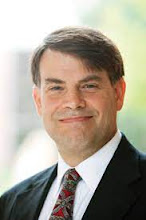
3. Wayne Schmidt has done a spectacular job of making Wesley a seminary for the whole denomination and beyond.
Wayne was of course a well-known church planter, a gifted and insightful leader, and a large church pastor within the Wesleyan denomination. He took Kentwood Community Church in Grand Rapids, Michigan from a church plant to a large church that became the mother of numerous plants, the grandmother of more, and even a church planting great-grandmother (it may even be a great-great grandmother by now). In his last years there, he felt God leading him to move Kentwood to look more like its surrounding community, which was incredibly diverse. And God did it!
God also worked out the timing perfectly for him to come to Wesley. He was sensing that perhaps God was wanting him to step out of Kentwood. He was wondering if God had been grooming Kyle Ray to become the next pastor of Kentwood.
While Wayne was pondering these things, several at IWU were dreaming of how great it would be if Wayne would be interested in being the first full-time head of Wesley. Wayne was stepping out in faith that God had something else for him. Imagine his surprise when Keith Drury and Russ Gunsalus showed up at his church one Sunday to put a bug in his ears about Wesley. Wayne resigned from his church with no certain future, and God answered with an offer from Henry Smith to lead the first Wesleyan seminary.
3. New leaders bring new strengths. One thing I've learned about leadership is that there is no one formula for a successful leader, just as there isn't just one type of pastor. Different leaders have different strengths and weaknesses. Good leaders leverage their strengths and manage their weaknesses.
Part of Wayne's testimony is that he did not initially think that he was the right type of person to be a minister. He had certain talents in the area of business. But Dick Wynn convinced him that he could use his business skills in the pastorate, and history has proved him right.
We started copying Wayne in emails even before he officially started. At that point, it was Russ as COO, me as Dean and half-time Bible professor. Bob Whitesel was our Leadership guy, and Chip Arn was our Missional Church guy. Karen Clark was our infrastructure. Nate Lamb was admissions. John Drury came on as a theology professor January 1, 2010 at the same time that Wayne started.
One of the first things that Wayne did was to put together a Seminary Board, which quickly became a subcommittee of the university Board of Trustees. I well remember that March dinner when Wayne brought in Keith, Russ, and me to share the founding vision of the Seminary with the newly constituted board. One of the most memorable moments for Wayne and me was when John Ott asked if we were going to be teaching a lot of higher criticism of the Bible in the Seminary. I responded that while no one loved the irrelevant more than I do, our curriculum would focus on the practice of ministry. We still laugh about that moment.
He also started as we were in the middle of a search for two new faculty. We would only snag one that summer, Lenny Luchetti, our proclamation professor. We were all concerned that the Seminary thus far was pretty much a group of while males. Wayne especially, having just built a multi-ethnic church in Kentwood, worked hard to try to find diverse possibilities for the next faculty hire. We diligently pursued a number of possibilities, but none of them worked out, for various reasons. Diversity was a value of the broader university as well, and Wayne soon would play a major role in that initiative.
One thing I noticed early on about Wayne is that he never stops. He is always making connections. He is always working to build the Seminary and the kingdom of God. He doesn't sprint, but he doesn't stop. That Spring he and I rode together to Christianity Today and met with Harold Smith and David Neff. Those were the sorts of connections that Wayne seems to form in his sleep.
By the summer, Wayne had already hired Joanne Solis-Walker with a view to launching our MDIV in Spanish in January 2011.
4. More on the unstoppable force we know as Wayne Schmidt as the years have gone by. I thought I would end this first post with the top 10 leadership lessons I have either learned from Wayne or observed in Wayne:
- He is completely submitted to God. You can't motivate him by ambition, honor, or acclaim. He does what he does because he is a servant of the Lord.
- He is humble but self-confident. He does not think himself better than anyone else even though God has blessed him with considerable gifts.
- He is a prayer machine. Everyone in the Seminary knows that he prays for them regularly.
- He is a mentor. I don't know how many people he is currently mentoring. He doesn't tell anyone. He does not seek reward for it. But he is clearly mentoring a lot of people in a lot of places.
- He cares what others think but he does not seem to get torn up about it. This is a real gift and one that I have not mastered. There are some people who do not care enough about what others think. Then there are others (like me) who waste a lot of time being troubled about others even when they are the one with the problem. Wayne is a model to me of someone who treats others with grace even in disagreement, but who doesn't waste a lot of time fretting over it either.
- Wayne knows how to be silent. This again is an area I struggle with, for I like to share what I know with others. But this is often a weakness. I believe good leaders are able to stay silent and only discuss information to the right people at the right time.
- Wayne can make hard decisions but he makes them with compassion.
- Wayne makes connections in his sleep.
- Wayne has a gravitas and a presence in public. His introductions are always orderly and eloquent.
- Everything Wayne touches, grows.