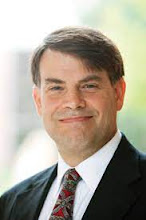
Keith Drury the Churchman (2)
In 1997 I interviewed for a teaching job at Indiana Wesleyan. I think Keith had only been in the Department of Religion for a year when I interviewed.
He always warned new faculty coming from the church how much more material is involved in teaching a college class than in giving seminars in the church. I seem to remember him warning Charlie Alcock when he came on how much more material it took to fill out a three-hour class than the kind of stuff he had presented going around to churches. I forget the exact amount, but it was something like he had used up all his existing material for a class in the first month.
2. I interviewed for a New Testament teaching position. Bud Bence (then chair) expressed well the philosophy of the Department of Religion (DoR) at that time. They aimed to hire "thoroughbreds" who could teach more than one subject. Also, there was a clear emphasis on the church -- experience pastoring was considered a premium to teach in a department whose main purpose was to train ministers for the Wesleyan Church.
I don't remember many of the questions there at the Hostess House. There was concern I would be too academically oriented rather than church oriented. There was concern I would cause some blow-up by being too liberal (Bud had been burned as VPAA at Houghton over a professor -- a tussle that involved general officials, the general board, and believe it or not Harold Lindsell).
I was single at the time, and Keith delicately asked (in so many words) whether I was gay. I don't think I found any of these questions too surprising. I think I even chuckled at that last question.
One of Keith's last questions had to do with the fact that the DoR was a bunch of white guys. He asked that, given the current makeup of the department, if there were an equally qualified female professor being interviewed alongside me, who would I hire. And there was! They did hire her, but I was delighted to be hired anyway to teach philosophy for a year. That way, Bud could find out whether I was going to blow up the place or not. :-)
3. I think a lot of people would consider the next decade or so to be the golden age of the DoR at IWU. I think that had everything to do with Keith Drury. He set the tone. Yes, there were some very dynamic professors involved. In those days, I compared a good professor lineup to a zoo with lots of fascinating animals for the students to see. Keith shaped the direction, and he helped establish the boundaries.
I've often reflected on why those were such incredible years. I wish Keith had written a Tuesday Column on the recipe (maybe he has somewhere). IWU was at its peak under Barnes, so there was that. It was growing like crazy. It had money like crazy. It was building like crazy. There was something palpable when you stepped on campus. It was a taste of excitement. There was an energy. Many experienced it as a sense of God's presence on the campus.
Here's an attempt to express some of the values the DoR had in those days. We tacitly agreed on them, but Keith stood at the heart of them, I would say. And, to some extent, he policed them. He could whack someone verbally if they began to step in the wrong direction, so to speak. He had a way of establishing one of those invisible fences that gives the dog a little zap if it tries to cross the boundary.
- It's all about the students. Your job as a professor is not about you. The university does not exist for you. It is not here to facilitate your career as an academic or to help you get to your next job or to help you publish your research. IWU is a teaching institution, not a research institution. Research is nice. Some do it in the summer. But you had better work to be a good teacher for the students during the year.
- IWU belongs to the Wesleyan Church. Neither the faculty nor the Board of Trustees nor the administration decide what IWU believes. The Wesleyan Church does. Want to debate women in ministry? Go somewhere else. Want to debate issues of sexuality? Go somewhere else. The Discipline and the general conference of the Wesleyan Church holds the title deed to your property, and that's that. The General Board of TWC could fire the entire Board of Trustees of IWU if it saw fit.
- You're training them for ministry. Prioritize your teaching based on what will be most useful for a pastor. Keith always said that a New Testament Survey class should aim to equip a nursing major to lead a Bible study. That was the persona he gave me. Do you need to teach them about Q? No. Do they need to know the life and teachings of Jesus? Yes.
- You're here to serve the church. Every once in a while, an issue would rise in the church over something. Maybe someone claimed to find the bones of Jesus. Keith might give a nudge. "You're up, Ken. This is what we keep you around for."
- The church gets to decide what's good for the church. No doubt the church can be wrong, but it doesn't matter. They'll only listen to you if you're on their frequency. Otherwise, you're just some lunatic talking to yourself at an institution bleeding students. We always shook our heads at the fools who thought they could logically convince the church (or the board) that it was wrong with a very nicely written position paper.
- It isn't just about truth. Truth isn't what wins all the time. In fact, it loses regularly. Power is what wins, and the power often comes from constituencies and from boards of trustees. Respect the snake or it just might bite you.
- Get out there. Don't stay in your cave talking to yourselves. Be out there preaching and teaching on weekends in churches. If they don't want you, that's a warning sign for you.
- We enjoy having lunch with each other. I realize there can be legitimate pushback on this point, but I think it is still more correct than not. The department should enjoy hanging out together. The synergy of good relationships in the department is contagious for the students. We had Friday lunches together. One of the unspoken hiring questions was whether we would enjoy going to lunch with this person, the "lunch" test.
- The cocurricular is important too. To be honest, in the 2000s, Keith probably was more interested in getting the students to study rather than do youth camp on campus. He famously thought that the number one problem with students was a lack of sleep. Todd Voss was part of IWU's success at that time by running a super co-curricular program. But I think Keith would agree with me that the co-curricular is an essential component to a thriving college.
Those are just a few of the values that I think made the DoR such a great success in the 2000s, and Keith was the primary force steering them, in my opinion.
4. I think Keith regularly gave President Barnes advice as well. Keith once told me that he didn't think he would be up to the challenge of being a college president. Of course, that was hogwash. He would have made a spectacular college president. But he took his hat off to Barnes' abilities at the job.
One of the reasons I gelled so well with Keith was his sense that form should follow function. Form for its own sake is great in art. But in ministry and business it's self-defeating.
Apparently, President Barnes had this committee known as the PACE committee. On it were all the innovators in the university. It completely ignored the official structure of jobs at the university. You might have a subordinate on the committee and their boss not there. You might have an insightful faculty member but not their department head or dean.
But it consisted of the most entrepreneurial elements of the university, a kind of steering committee. And Keith was probably the most insightful voice there.
The Higher Learning Commission and countless others always mocked IWU's structure, which had the online and adult people doing one thing and the residential campus doing another. But this was growing things where they would grow. I have long said that if Barnes had put the online and adult programs under the control of the residential faculty, they would have killed them within a couple years.
This was also the genius and spirit of Keith. And frankly, this is the way God designed the universe. Things grow where they grow, and they don't grow where they don't grow. Many humans say, "No, no, no, you have to grow here." But the plant doesn't care. The plant says, "I think I'll die if you plant me where you want to." People who design structures so that the org chart looks pretty and symmetrical -- rather than it being functional given the people you have -- these are not Keith-level thinkers.
5. Keith had retired by the time the most recent talk about tenure at IWU took place in the late 2010s. Barnes had done away with it before I arrived on the scene. I'm pretty sure my thoughts were the same thoughts Keith would have had (I probably emailed him about it). "This is a non-starter. All this fuss is a waste of time. The board will never approve it." My next Keith thought was, "David Wright has to know this. I wonder if he's letting them have this conversation to feel good about themselves and, after all, it keeps them out of trouble." But, perhaps with a wry grin, "It's never going to happen." :-)6. One danger of such organizational and human savviness is the development of a kind of culture of cleverness. I don't think Keith had this. But perhaps I and one or two others got a little too cocky on the street smarts we absorbed from Keith. It's not the right attitude, but I'll confess I did develop some of this.
Steve Horst, Russ Gunsalus, and I used to have our philosophy classes watch a clip on Socrates from an old movie called Barefoot in Athens. There's a line about Socrates in the movie from one of his accusers that always makes me laugh. "Socrates taught a devilish ingenuity in logic which worked on men like a magic... the worst men of three generations." I always laugh when I think of that line and think of Keith. Of course not that he trained the worst of us or taught leaders to be manipulative. No, but he did teach leaders how to strategize, a power that can be used for good or ill. He understood how people and the world actually works, regardless of what we might say or think about ourselves... regardless of how we think it should work or want it to work.
I'm sure he wasn't always right, but he was always strategic. You get the best you can get with the choices you have with a view to the long-term plan. Plan for sure, but your plans will inevitably have to be changed along the way. Don't plan too long, or you'll miss your window. He used to say that most mission statements were outdated by the time they were finished. They tended more to be a reflection of where you'd been than where you would go, which God and circumstances would ultimately decide.
Keith's genius with people sometimes reminded me of the scene in The Matrix when the prophet tells Neo not to worry about the vase. He turns around and knocks the vase over, breaking it. But he wouldn't have broken it if she hadn't have said anything. Sometimes Keith said or did what he felt like needed to be said or done to get you where you needed to be or to go. Some might call this dishonest, but I bet God does this. God knows what we need to hear to get us where we need to go.
Tim Kirkpatrick was telling about how Keith told him he wasn't an A student and so he should just try to be better than a C student. In retrospect, Tim thinks Keith was just saying what he needed to hear to inspire him to become an A student. Some might call it dishonest. I think God probably does this with us because it is the direction we are moving in that is important.
Words are "vectors." They have a direction. Two people can say the same thing and one be loving and the other be hateful. Most of us point our words in certain directions without thinking about it. We sting or we build up instinctively.
People like Keith are on a whole different level. They are aware and usually intentional about trying to move you with their words. For Keith, his words were always trying to move you towards God and virtue. For others, such pointing can be very selfish and dangerous. Some of the scariest people are those who wield the weapon of rhetoric with great prowess and are thinking three chess moves ahead of you.
7. I would say I paid little attention to a lot of these things in my first years at IWU. I had fun and, in a happy go lucky way, didn't take things as seriously as I should. When I went for full professor, I turned in a plain manila folder with a rubber band around it.
For some context, it's hard for professors these days to realize how little assessment, how little paperwork, how little structure there was to things 20 years ago that today are amazingly specified. When others took over for me at the seminary, they wondered where all the additional paperwork was. It just hadn't been required even as recently as 2008.
I probably published more at IWU in those days than anyone else on campus, and I did it with publishers like Cambridge and in the flagship journals of my discipline. Only Michael Boivin and I were doing things like Fulbrights in other countries. I knew I easily met the criteria for rank promotion.
Keith very patiently came to me from the committee. "Ken, we know you've published a lot. But being a full professor is a big deal. You could at least present your materials in a more professional way." So I bought some more folders and some tabs and prettied it up. Even five years later they would have made me wait a year. I know he was being incredibly kind to me.
I'm sure I frustrated him on occasion. There were days I felt like he may actually have kept his door closed so he wouldn't chew me out on some stupid thing I had done. I often appeared in his doorway as did countless students. He was very, very patient with me.
8. I saw an opportunity to write a New Testament Survey for the adult and online program, and I seized it. I wrote it, like Keith, for ordinary people. From what I heard, the students loved it. Eventually, there would be those who thought it wasn't academic enough. This is the disconnect I write often about.
Keith generously read every word of the manuscript. I didn't deserve that. My wife Angie doesn't even do that. He was forthright and helpful. "Drip, drip, drip" -- you've said this ten times Ken. Is it really that important? He steered me away from the kinds of things that could cause me problems, although I was already sensitive about those things.
8. Everyone in the DoR no doubt has their own stories of Keith. I remember a story about him and Steve Lennox traveling together and Lennox being very frugal in his approach to things. Apparently, Keith might intentionally drop some of his change at a gas station knowing that Steve would pick it up.
Keith led students to Turkey a couple of times, as I recall. He let the students plan it all. He wouldn't help them. They had to figure things out. I think they even left one person behind at Istanbul because he didn't get to the meeting point when he was supposed to. I would go to Turkey with Keith in 2013 with Ross Hoffman and David Ward. Those were great memories too.
We had a general plan, but Keith didn't like to plan out those sorts of trips, much to Ross Hoffman's discomfort. It was his style not to have reservations at a hotel. You just found one when it was time to find one.
The thing is, Keith was smart enough to do that. He knew he could figure it out on the spot. I remember in the middle of Turkey he just got in the car with someone who was going to show us a hotel to stay at. We followed them. I thought, what in the world is he doing, getting into a stranger's car in the middle of Turkey.
Enough for now. Maybe one more post on the founding of Wesley Seminary.