Thursday, August 08, 2019

Year 6 at IWU (2002-2003)

0. 1997, Year of the Hire
1. 1997-1998 First Year Schenck
2. 1998-1999 Married Schenck
3. 1999-2000 Go New Testament
4. 2000-2001 Williams Prayer Chapel
5. 2001-2002 The Year of 9-11

1. I did a quick sweep of what class records I still have to look for students I had this year. Please chime in if I miss you!
  • In New Testament Survey, I see I had Aaron Duvall, Clint and Jamie Ussher, Joy Arroyo, Carl Rudy, Chris and Rachael Demarse. 
  • Fall of 2002 in Paul's Earlier Epistles, I see Josh Bowlin, Brian Cooper, Paul Kind, DJ Murvine, Mark Schmerse, Marc Ulrich, and others.
  • In the spring of 2003 for Paul's Later Epistles I see Kurt Beard, Blake Chastain, Seth Harshman, Alicia (Rasley) Myers, Devin Rose, Dave Schreiner, Ali Walls, Dave Wingfield, Debbie Wooters, Kevin Wright, and others.
  • In my philosophy classes that year I see names like Mike Cline, Matt Beck, Tiffany (Good) Meador, Patrick Cooper. Kari and Josh Jackson, Jamie Ussher, Barton Price, Jonathan Parsons (who went on to PhD in philosophy), Kim Veenkant, George Wooten, Blake Chastain, Brent Dongell, Scott Ferguson, J Fry, Kara Kensinger, Tom Seat, and more.
I was privileged in the spring of 2003 to be chosen by students as the Professor of the Year.
2. 2002 saw the arrival of the phenomenal Chris Bounds to the Religion team. I had known him at Asbury. He is truly a man in whom there is no guile. Before he was married, he committed to never own more than he could fit in his Volkswagen. Then he got married.

Chris and I would take playful jabs at each other in our classes. He would ridicule my heresy, and I had an imaginary "Bounds mitre" I put on when students wanted to know the right answer to a question, and I needed to speak for the church. I think this sort of back and forth made studying in Noggle fun. It showed that we were all friends, indeed a family the students were part of.

I don't know when the Friday lunches developed. Most everyone who wasn't teaching at the lunch hour on Fridays would go over to Baldwin together. We would laugh and have an uproarious time. More than once students would say, "We try to imagine what you all are talking about." Some imagined we were having deep conversations but... NOT! We were just being friends.

And so developed a key question in hiring in those years--the lunch test. Is a candidate someone we would like to hang out with and go out to lunch with? There are of course some dangers to that question because it can inadvertently promote homogeneity. But it certainly promoted a sense of family that was part of the secret sauce.

3. Chris Bounds introduced us all to Tom Oden and to the consensus of the church. (Although I did hear Oden give his testimony at Asbury College around 1990. He was so above my head that I couldn't even understand his testimony.) I would come to draw on the concept of the consensus fidei heavily because it allowed me space to let the Bible say what it seemed to say while affirming orthodoxy as the end goal God had in mind.

Bounds is sneakily brilliant. I say sneakily because he doesn't tell you how much he's read or how much he knows. He has no interest in acclaim or notoriety. When you are saying heretical things, he calmly might shake his head up and down and say, "Yes, yes, that would be one of the worst heresies there is." He has an irenic spirit, although he certainly can get into the "Bounds bounce" when he is talking about heresy in a lecture.

I once remarked that he was the greatest theologian the Wesleyan Church had--and of course he is United Methodist. :-) We are now seeing a slew of great Wesleyan theologians in our schools--Jonathan Case, Josh McNall, Jonathan Morgan, John Drury, Jerome Van Kuiken, and more. I'll even get a shout out to Tom McCall, that traitor at Trinity. :-)

The Wesleyan Church would draw on Chris a lot for that decade, especially for a brief revival of the doctrine of sanctification. It seemed to me that, for a brief moment, even the general superintendents were open to letting the doctrine drift away. You might remember Keith Drury's famous presentation in 1995 entitled, "The Holiness Movement Is Dead." For a short period of time, Chris stood at the center of a revival of the doctrine. He was even asked to present on it at the General Conference of the Wesleyan Church in 2004--the shorter, longer, and middle ways.

Chris was a model Noggle professor. He was a brilliant scholar to be sure. But he was a pastor whose first love was the church. He was a mentor. He was sanctified. He was practical.

We lost him to Asbury University in 2016. I think there are lessons to be learned around his departure, but I will leave it at that. I said he'd be back at IWU in three years. Well, you can't be right on everything. :-) Currently, STM is blessed to have Jonathan Morgan, who was voted most popular professor in STM this year by students. So STM is in good theological hands.

4. That winter and spring I was desperately trying to finish my New Testament Survey book. I remember Nathan Birky catching me on my way back from lunch or chapel about the name. He didn't think "Snapshots of the New Testament" was good enough. Did I have a better idea, one that made a strong spiritual statement?

As we walked by the prayer chapel I said, "How about 'Jesus is Lord'?" This was probably the very first Christian creed, possibly confessed by Christians right before they were baptized (Rom. 10:9). He liked it, and so it would be. Jesus Is Lord came out in September.

I had some spectacular writing days that winter between Christmas and New Year's at Hilton Head. My family and Angie's parents were with us. I would slip off to the Barnes and Noble to have coffee and write. It's one of my favorite writing memories, in the cozy inside warmth of winter.

5. The spring of 2003 was the first World Changer ceremony. Barnes and board chair Lyle Reed had got the idea from a book by the late Rob Briner, Roaring Lambs. The idea was to recognize Christians in the secular realm who were changing the world for the better. (Ministers could not be chosen). These were meant to be models of what we were training our students to become like.

With each new inductee, a bronze statue was put in the rotunda in the library. Over the years, students and faculty have been more happy about some choices than others. I'll leave it at that.

6. On Spring Break 2003 (March 1-5) several of the Religion faculty went with Wilbur and Ardelia Williams to Greece/Turkey (she had just retired in 2002). Meanwhile, on March 20, 2003, President Bush unleashed "shock and awe" on Baghdad, just a couple weeks after we had returned.

To say I was paranoid on those flights is an understatement. Just this week, at the STM farewell for me, Steve Horst recounted the story of me standing in the aisle on the plane much of the flight, scanning the passengers for possible terrorists. We all knew the war could come any day. Powell had already made his case for weapons of mass destruction to the UN security council in February.

On that flight also was Cheri Horst, Bud and Carol Bence, Steve and Lori Deneff, and more. In those days Wilbur made sure that every faculty person in the Religion Division made it to the Holy Land... on his dime! On this occasion, he paid for my entire trip to biblical sites in Greece and Turkey. For that I am ever grateful.

Unlike his Holy Land tours, Greece required a Greek tour guide. This was a little annoying. We were a Christian group interested in biblical sites, not a group wanting to know about Greek history in general. Abson Joseph and Steve Horst's current tours are much better.

So they took us to Delphi. Of course I loved Delphi. There is a great Greek restaurant there. But it's not exactly a biblical site. I remember Steve Deneff being struck by the similarity in structure between the pagan temple there and the Jerusalem tabernacle. I remember David Thompson at Asbury mentioning this fact as well, once upon a time.

It leads to an important paradigm shift, I think. When God commanded the tabernacle and temple to follow a certain form, he was largely drawing on a temple structure that already existed. God meets people where they are at. God incarnates revelation. He starts with where we are and goes from there. God contextualizes revelation.

7. Steve Deneff came to College Wesleyan Church in 2001. He is of course a spectacularly wise and godly man. I love him to death.

Of course it used to be pretty clear that some of us faculty were quite annoying to him from time to time. Imagine all the emails you might get from a college community. You use a physics illustration, you get a corrective email from a physics professor. You say something about psychology or physiology, you get an email from some professor. I think I only emailed him once, in his first year--something about Pharisees.

In response, he would mock us from the pulpit from time to time. "I'm going to get emails about this." :-) I'm looking forward to Wes Oden at Houghton. :-)

The year between Joe Seaborn and Steve (2000-2001), we had an embarrassment of riches in the preaching of Steve Lennox and Bud Bence. In the fall of 2000, we had both Tom and Sophie baptized as infants at College Wesleyan, something not uncommon among millennial Wesleyans. Bud preached the sermon and Keith Drury did the baptism.

Bud's message was striking to me (as always). Wesleyans can baptize infants because we do not believe that baptism saves a person. In my view, infant baptism says, "You are in the church unless and until you walk away." Believers baptism says "You're outside the church until you get a brain." It makes our children outsiders, foreigners in the church until they get old enough to join the club.

8. In the Greece trip we went to Corinth. I was very excited about this. But at the key moment, I forgot about the inscription funded by Erastus (cf. Rom. 16:23), down by the theater. Of course we spent some time in Athens. I remember Nick Deneff taking some food off some vendor's cart there, thinking it was a free sample like at Sam's Club or something. He didn't realize you had to pay. :-)

From a scenery standpoint, the Isle of Patmos wins. WOW! From an archaeological perspective, Ephesus was phenomenal... WOW! The cruise ship docked and we had three hours, I think, to go through the extensive site. I would later visit Ephesus again with Ross Hoffman, David Ward, and Keith Drury in 2013.

My first book came out in July 2003, Understanding the Book of Hebrews. I spent a good deal of time on the cruise across the Aegean working on the index. Man, that was a lot harder in those days!! Now we just do a search on the print ready PDF.

9. In 2003, the new Jackson library was finished, and the library moved from Goodman to Jackson. Goodman is currently where the Honors College and School of Teacher Education are located. I remember talk about the committees that designed the new library. Keith Drury, if I remember correctly, thought that the McConn coffee shop should be in the library and that there should be a decisive shift toward online resources. These ideas obviously encountered resistance.

So McConn, the true center of campus, was put in the student center. I wonder what would have happened if it was in the library! Would the library then be the center of campus?

Fifteen years later it is still not clear to me that we will eventually go entirely to e-books. In fact there was a major misfire in this regard in the early 2010s, when CAPS tried to move to e-books. It turns out that the typical adult IWU student didn't want them. It seems that I made double royalties on my NT Survey one year because they ended up having to send the paper books after billing the e-books. I mean, I took the money, even though I felt sorry for the students. :-)

10. In the fall of 2002, David Wright took over the graduate program in religion. From this point on, it would be a little more detached from Noggle because it was now housed in a new unit called the College of Graduate Studies. David would save the program by putting it online. I remember the first planning meeting upstairs in what is now Maxwell.

His approach was to reformulate the degree around "low hanging fruit." So with Bounds in town, "Theology of Holiness" seemed a good choice. Steve Lennox wrote a Biblical Interpretation course. These were all eight week courses. A cohort model was used, and I adjuncted for the program in Marion, Indy, and Fort Wayne.

I believe it was somewhere around this time that Dr. Wright hired Bob Whitesel, the only fully dedicated faculty member in the Grad Ministry program.

11. It was during this 2002-2003 year that College Wesleyan started what it called the "Cathedral Service." For some reason I feel like Judy (Huffman) Crossman asked me, although I think she was still Dean in CAS at that time. They asked Bud first but he declined. I have her down as Dean from 2000-2004. Then she went to work as the pastoral care pastor at CWC from 2005-2015. For a short time, she actually had her office with us in the Religion suite, even though she was in psychology at the time.

It was a liturgical service, based on the Book of Common Prayer. It was a small but dedicated crowd, and we would "pipe in" the sermon from the main sanctuary live on screen. We did communion every week.

On Easter Sunday, April 20, 2003, I was giving communion when it became evident that something was happening with my face. Keith and Sharon Drury wondered if I was having a stroke, although my brain seemed normal for me. :-) I had noticed a certain numbness in my mouth the evening before driving Stefanie to Kokomo, as I remember.

After the service, we drove to Kokomo to have an Easter meal and do our usual egg hunt with Angie's parents. I dropped the family off in their beautiful Easter clothes and then drove to the emergency room. Although I don't remember anyone in my family ever having it, I discovered that I have the gene for Bell's Palsy. A nice steroid shot and some strong antivirals, and I was back for Easter. A few months later my face would return to my normal.

12. In my sixth year as professor, I had the privilege to apply for sabbatical. Given our love for Europe, we decided to try for Tübingen, Germany, where I had spent two months during my doctorate. I applied for a Fulbright.

It seems to me the key for a Fulbright is to have a sponsor of sorts at the university where you want to go work. I had worked with Hermann Lichtenberger when I was there before in 1995, so I reached out to him with a project to work on. I was very grateful to be awarded the grant.

Angie's mother was quite excited to come visit us in Germany. For our fifth wedding anniversary, Angie and I went on a cruise, while her parents watched the kids. (I was actually nervous to be away from them for several days). When we returned, her parents took Stefanie and Stacy on a trip out west, along with two other cousins. Angie was still working as a youth pastor at Main Street UM and went to Epworth Forest Camp that week while they were gone, while Tom, Soph, and I stayed home.

Friday night I went to pick up Stef and Stacy from their trip. The next morning Angie's mother would die of a heart attack. June 28, 2003.

Wednesday, August 07, 2019

Year 5 at IWU (2001-2002)

0. 1997, Year of the Hire
1. 1997-1998 First Year Schenck
2. 1998-1999 Married Schenck
3. 1999-2000 Go New Testament
4. 2000-2001 Williams Prayer Chapel

1. 9-11. This was the year of 9-11. I was teaching New Testament Survey upstairs (northeast room over the then east entrance) in Noggle in a 7:50 class when it happened. [1]

When I came down from class, Cindy was in Russ Gunsalus' office and informed me that both of the towers were down. I had hardly paid any attention to them on our way back from Boston a couple years back. I was much more interested in the Empire State Building and considered them ugly.

If I remember correctly, I pulled up NPR on my computer and listened non-stop for days to come. I remember the shift from focusing most on matters in this country to paying greater attention to the world situation. Whereas I used to listen to "Bob and Tom in the Morning" on my way up to Notre Dame, now in the spring of 2002 I would listen to NPR. For years thereafter I listened to NPR.

I am paranoid by nature. So I am not completely unsympathetic to our mayor at the time, who had barricades put around the Marion courthouse. In retrospect it seems quite silly, but it was a shock. No foreign power had attacked the US with any real success since Pearl Harbor. I had felt completely invincible. So where else were these terrorists hiding? Were there cells all over the place, even in Marion, Indiana, just waiting to jump out at us?

They weren't. The mania that looks at all Muslims as terrorists is simply mistaken on the highest of levels. This sentiment persists in our culture today, although now the climate has subtly shifted the unfounded paranoia to illegal immigrants. It's as if we have somehow forgotten the "evil Muslims" in favor of the "evil illegals." We humans are so easily manipulated by our fears and prejudices.

I had little sense of Afghanistan at all prior to that day. It was fascinating to learn of individuals who had the entire Quran memorized but couldn't read. I would use that as an example of the nature of oral cultures and how the illiteracy of biblical times is no indication of their intelligence.

2. In the fall of 2001 I tried out something new with Greek. My proposal was to teach all the categories of Greek the first semester, teaching how to use Greek tools, and then to teach all the forms to memorize the second semester. There were a number of things going on here. First, there was my sense that most Greek students spend all their energies memorizing charts and can barely remember the functions, which are what is really important. Then they forget all the forms over the summer anyway. At one point I mused that most Greek students lose 95% on their investment--not a good deal.

Then there was my sense that most ministers who use Greek end up using the "cheat" tools anyway. Sometime around here I went to a free Logos software seminar in Chicago and received this software on a special offer. For the next fifteen years in Noggle and the Seminary, we would occasionally ask ourselves whether to require students to buy Logos as part of the overall curriculum so they would have research tools for word studies and such. We always decided not to, and, as materials have become freely available, it has seemed less and less likely a suggestion.

2001 was before blueletterbible or interlinearbible.org. So I had the students buy a hard copy of Freiberg's Analytical Concordance. In the first semester, we used its code to tell us what the form was, while the course focused on what the tenses, cases, etc meant. The goal was to teach first what most students would actually remember after they had forgotten all the forms.

I started a Greek textbook, Purgatory Made Easy, which was to go along with the class. Jerry Pattengale even negotiated a contract with Triangle for it, which I never found the margin to sign, so it faded away. I've taught Greek at least three more times that way, and set up the seminary's Greek and Hebrew for ministry classes that way, so that students could get the bulk of Greek categories in one course.

Last year I taught Greek that way and more or less finished the textbook, but I have been unable to find a publisher for it. No surprise there. There's little market now for such a book. And of course the college has shut down Triangle, for good or ill. The college has long since stopped mailing out textbooks too to adult students.

I felt guilty for not leaving that layer of students with a solid Greek textbook. I bought Alicia (Rasley) Myers a copy of Machen so that she would have a reference tool going forward. She would go on to do her master's at Duke and her PhD in New Testament at Baylor. She taught at United Seminary for a short bit and is now at Campbell in North Carolina.

David Schreiner was also in that group. He would go on to get a PhD in Old Testament at Asbury Seminary.

3. I think I taught Paul's Later Epistles for the first time in the fall of 2001, just as I had taught Paul's Earlier Epistles for the first time the previous spring. We would break these courses up into more focused Bible classes during the period when IWU was at its peak. We were on the rise at this point. I see that the residential campus was at 2200 at this time, with 5000 adult learners either online or at a satellite campus. In spinning out worse case scenarios, there are some at IWU who are sketching out what it might look like to reduce to those sorts of numbers again in the demographic trench of 2026 that is coming.

STM also was starting its worship major at this time. In my preparation to move I came across a document in the fall of 2000 proposing a worship major, drafted by Keith Drury. I believe the major started this year with him teaching the key courses. His book, The Wonder of Worship, came out this year (2002).

Over the years, I have seen some academics ignore his book because it is so practical, especially for Wesleyans where they are at. I saw that happen at the seminary. We started using it because it was so practical for a Wesleyan minister. Then it was taken off the required list as being too popular. This is the personality of the academy. Rather than give students both the sugar and the vegetables, we just give them the vegetables. Then we are surprised when they don't sign up.

At its peak, IWU and the Division gave students both sugar and vegetables, and they came in droves.

4. In the spring I taught Intertestamental Literature for the first time (I think). That class had Mandy Drury and Dave Schreiner in it, not to mention my partners in Deep Thought FNL humor Dan Stellar and David Wingfield. Mandy has told me several times that this was the class that most prepared her for Princeton. The forces that have ended the teaching of Latin at IWU have also ended the teaching of this course.

I would always tell students in this class that the intertestamental period was the lens through which Jews at the time of Christ read the Old Testament. That is to say, the New Testament may draw on the Old Testament for the materials of its theology, but the form that it gave to those materials was largely a function of the currents between 200BC and Jesus. It was during this period of time that belief in resurrection became dominant. It was during this period that zeal for the Law revived and took on its New Testament form. Our sense of Satan and angels was heavily impacted. In short, we think we are just reading the Old Testament, but the NT authors were wearing intertestamental glasses.

5. Nathan Lail reminded me that he had me for philosophy the fall that 9-11 happened. I looked it up and others in that class included Jason Berry, John and Danielle Freed, Tom Cochran, Jonathan Dodrill, Kristen Haines, Tim Nettleton, Daniel Schwartz, Joe and Jeff Locke. It met in the large room on the far west side of Noggle.

From either Joe or Jeff Locke I learned the expression "Motion brings emotion." I was teaching Aristotle's sense that habit can form virtue--fake it till you make it. I've sometimes gotten theological push back on this notion because we don't believe you can become truly good in your own power. Fine. But it is nevertheless true that virtuous behavior can be formed by habitual actions. It becomes muscle memory. "Motion brings emotion." Act lovingly toward your spouse long enough and the feelings of love will follow (cf. Fireproof).

6. In summer 2002 my family would move to our current house near the hospital. We had redone my attic on Harmon into a room for Stefanie and Stacy, but it was just too cramped and too cold/hot. I would rent out the Harmon street house to David Wingfield and friends as they finished up. David ran FNL in those days. Dan Stellar was on a trajectory to make movies. They did a couple video shorts with me. One was called "Schencko" (after Psycho). Then Dan did one with my son Thomas called "Turbocaf," with him bouncing up and down with the tape sped up.

7. In the spring of 2002, Jim Lo, Keith Drury, Burt Webb, and I ran/jogged/walked the Indianapolis marathon. For me it was on a whim. I had not trained. Jim Lo ran the whole thing and then came back and walked with us. I jogged eight miles then walked the rest.

Burt was a biologist who would end up becoming a Dean at Northwest Nazarene and is now president at the University of Pikeville in Kentucky. IWU has produced a lot of college presidents over the years. It is a testament to the winning DNA of those years. IWU in those days was like a leader incubator, and once you got the bug, it would become increasingly difficult not to express it in some form of academic leadership. Yet there can't be too many cooks in the same kitchen, so people end up having to go elsewhere to let the genie out of the bottle.

We had some great discussions over lunch. At that time, if I remember correctly, Burt wondered if Adam and Eve were the first humanoids into which God put a soul. Of course the genome has since thrown wrinkles into that hypothesis. At some point in those years we started having Monday Reading Group. Each Monday we would go through a book of some interest. On the soul, for example, we would read Joel Green's book in 2008. In 2012, we went through the Catholic Catechism and created notes on it from a Wesleyan perspective.

8. In the summer of 2002, I began doing a little adjuncting for Asbury online. I was not a particularly good online teacher in those days. I would like to think I have improved. I have sometimes found that a person who is dynamic in the live classroom is often not naturally gifted online. On the other hand, I have known teachers who are phenomenal online and yet pretty average in the live classroom. I link this phenomenon to the fact that online has typically required strong administrative skills, while personality sometimes carries the day face-to-face.

So it is with some sheepishness that I remember that Kyle Ray took Matthew IBS with me in 2004 online with Asbury. Sorry Kyle! A great insight here for me is to "Leverage your strengths; manage your weaknesses." [2] With the advent of Zoom and other conferencing softwares, I have often since modified my online classes to a hybrid of face-to-face and asynchronous.

9. In our current hyper-administrative form of doing university (the rise of managerial academic culture), young academics are often dumbfounded at how little paperwork we comparatively did in the early 2000s. I remember how hard Cynthia Tweedel worked to get us to do assessment. It was a thankless job. I still get emails from the seminary occasionally asking for things like master course outlines from the founding of the seminary. There were no such things in 2009. There was simply the course description and the course outcomes. And frankly standardizing these and having the outcomes on file was a development that largely took place during my first decade at IWU.

So in those days rank promotion was largely a reward for faithfulness. Were you decent in the classroom? Were you serving your department faithfully? Scholarship was great and over those years Barnes was slowly trying to tighten those screws.

But in my first five years scholarship was value added. When I first met Keith Reeves at SBL (Wesleyan at Azusa) after I started working at IWU, he was quite surprised for someone from IWU (or the Wesleyan Church) to be at SBL. And I even presented! This was all fairly tangential to my identity as a professor at that time. I felt like I did my scholarship on the side. A visiting scholar around 2005 even asked me, after visiting the campus, why I did it.

Things have long since changed. You will now find multiple IWU faculty at SBL each year with multiple presentations. In any case, I was approved for Associate Professor without any problems.

[1] Interesting story here of how we can infect earlier memories with later ones. For the last few years, I have thought I was teaching Inductive Bible Study to a class that included my first cousin once removed, Mark Shepherd. But in researching this, I realized I taught him in 2007, probably in that room. Kevin Wright then made the final correction--it was a New Testament Survey class that he was actually in.

The upstairs of Noggle at this time wrapped around the east and north sides of the building. Psychology had its offices in the southeast part of this corridor. Then the hall wrapped around the north to where Michael Boivin's office was (and I think later Tim Steenburgh's). There was a far removed classroom then at the end of the north hall to the west. I only taught in it once, I think.

Karen Hoffman remembers passing me going up those back stairs (I think) going to that classroom. I think I might have been joking but I said to her in passing something like "I hope I can figure out where my classroom is." She was horrified that I wouldn't know where I was going at that point of the semester. I've been told that my humor is an acquired taste.

[2] Now Discover Your Strengths.

Tuesday, August 06, 2019

Year 4 at IWU (2000-2001)

0. 1997, Year of the Hire
1. 1997-1998 First Year Schenck
2. 1998-1999 Married Schenck
3. 1999-2000 Go New Testament

1. The fall of 2000 was the Gore-Bush election. I wasn't really happy with either alternative. Voting was at Center School. Somehow I ended up in line with John Drury and Mandy Hontz, who were now dating in their senior year. I couldn't decide who to vote for even into the booth. I thought maybe I would vote for my wife Angie, but she wasn't on the ballot.

Finally I said to myself, "Ah, what harm can a president do?" And I let my childhood defaults take over.

In those days the Division seniors always did a prank during finals week. (with Bonita looking the other way) In Bud's last year as Chair, they put sod in his office (with a layer to protect the carpet). Another year they put their faces in place of the faces in the hall of fame in the hallway. There's a picture of this somewhere but I haven't found it yet. John Drury's year they camped out overnight in the conference room, remaking it into a dorm room. I remember now that the conference room then was immediately to the left when you came in the suite (a detail to fix on my office drawing--I believe a renovation later moved it to a room outside the north entrance to the suite by Russ and my offices).

2. In 2001 McConn chapel was finally torn down. And in 2001 the Williams Prayer Chapel was built. Wilbur Williams took a dollar salary a year and donated the rest toward the building of this chapel (where, incidentally, he and Ardelia will be buried). In those days, Wilbur owned a large number of the houses around IWU and so was blessed to be able to give significantly to IWU and to students. More on his trips to the Holy Land in a later post.

They didn't want the chapel built too big so that it didn't become a place for weddings and such but so that it would remain a place for prayer. Ardelia would retire from the art department in 2002. I found a liturgy for morning prayer that I led in September 2001, I presume in the new prayer chapel.

My friend Neil Evans from England would laugh at the thought that I might have been a regular at morning prayer in Durham. But I had gained a little knowledge of the Book of Common Prayer and the Anglican liturgy while I was there. I suspect that that service in 2001 made me somewhat of a go-to person for such liturgies in the early part of that decade. David Riggs would far surpass it with Coram Deo, but I believe I gave him starting materials for the liturgy. I ran the first Ash Wednesday service in the Williams chapel, although Constance Cherry and Emily Vermilya would far surpass it. And when College Wesleyan decided it wanted to have a "cathedral" venue in 2002, after Bud declined, I ran it for over ten years.

2001 was also the year that they significantly expanded the student center. Those were years that Brendan Bowen and Todd Voss were major players on campus, Brendan with buildings and Todd with student life. We used to gripe about Voss keeping the students too busy with co-curricular activities when they were here to get an education. In retrospect, I think they came as much or more for the campus life as for the classes, although relationships with faculty are the most important for student success, it would seem.

IMO, Voss was part of the secret sauce of those years. He's doing a spectacular job now as president of Southern Wesleyan, where he has finally been able to (almost) build his dream dorm. I say almost because he always dreamed of faculty living in dorms with students.

3. We had two new faculty come on board officially in 2000. Steve Horst had been adjuncting philosophy and counseling for some time. A Houghton grad, we finally had someone full time who actually knew philosophy! His wife Cherie adjuncted some too in those days.

David Smith also came to teach New Testament. I had been in some classes with Dave at Asbury (Dr. Wang's Romans, Dr. Lyon's Textual Criticism), but of course married and single students at Asbury didn't necessarily interact much. I ran into him again in 1996 in Durham as he was considering doing his doctoral work there. I believe I suggested his name to the Division.

4. I continued teaching my normal fare of large philosophy and New Testament survey classes. I taught Honors College sections in both the fall and spring. That fall was David Riggs' first semester at IWU also as the Director of the Honors College.

I see that Lisa Toland was in the fall section of Honors New Testament, and Alicia (Rasley) Myers was in the spring. Lisa would go on to teach in the Honors College, and Alicia is now quite a prominent New Testament scholar. Russ Gunsalus likes to point out that she was a youth ministries major.

I taught at Notre Dame again in the spring--another chance to get season tickets for football! It was about a two hour trip each way and I had it timed well. I could teach a 7:50 class, scramble to South Bend to teach, then get back in time for a class in the evening. Of course I felt like I was going to fall over during class up there.

5. I see I presented a paper on sola fide at the second Fall Religion Colloquium. Before long we would come to have them in both fall and spring.

I have long believed that the Wesleyan tradition stands somewhat apart from the high Protestant tradition of Lutheranism and the Reformed tradition. This is because Methodism arose from the Anglican tradition, not from European Protestantism. So just as the Anglican tradition has sometimes considered itself a via media between Protestantism and Catholicism, so I have considered Wesleyanism.

(For a brief moment while I was at the seminary, I even explored a publishing sub-group of Pickwick with a few scholars. Its name was to be Via Media and, in my mind, its agenda would have been to promote this sort of approach on a scholarly level. However, one tension was that my compatriots were largely post-liberal with a post-modern flavor, while my vision was for a post-conservative movement with a more critical realist flavor.)

Accordingly, most of the solas, in my opinion, do not apply in a pure form to the Wesleyan tradition. Prima scriptura ("Scripture first") is more Wesleyan than sola scriptura because of the quadrilateral. In my colloquium paper that fall, I presented the fact that works have always been important for the Wesleyan tradition in a way that has made the high Protestants nervous or outraged. Yet the new perspective on Paul has affirmed our understanding of the Bible. Recent work on grace has also made it clear that grace was not unconditional in a Mediterranean context (cf. John Barclay). David Riggs and Chris Bounds worked with students exploring such contours of grace in the early church.

I had the idea of an online journal that would preserve the papers from these colloquia, Quadrilateral. We actually took out some space on the indwes server and I did publish the first edition from the papers that fall. Unfortunately, as with so many of my ideas, it did not endure.

When the student center expansion was finished, we would shift to having these in one of the banquet rooms. Students would get their trays in the cafeteria and then come over to eat while professors presented their papers. It was quite a positive part of the life of the Religion and Philosophy Division in those days.

6. This would be my last year as Director of the Graduate Ministry program. David Wright would take over as Graduate Director the following year and put it online. This move saved the program.

I did some online work for the program that year, however. I wrote an online course for the program in the fall of 2000, one of the first. It was a course on Biblical Hermeneutics (MIN-511). One of the pieces I wrote for that course was "From Pre-Modern to Post-Modern Interpretation of the Bible." I was also supposed to write a New Testament Theology class online as well, although I have no memory of it. :-)

I revised the Research Methodology course. This was another case of me doing something that was really out of my field of expertise. I could do biblical research, but I knew precious little about quantitative and qualitative research of a more substantial, statistical nature.

I also ended up teaching the Capstone Project course a number of times. I had students like Jay Height and Matt Trexler. A funny memory is that Matt forgot to give his MA project a title. We always read the titles of their projects at the consecration service. So I made up one for him that he heard for the first time as he was coming to the platform. I made it particularly complicated. :-)

7. Jerry Pattengale has always been heavily involved with scholarship at IWU. I believe it was he who started the Honors College in 98. He would eventually become the major liaison between the Green Foundation and IWU. He is currently the only University Professor at IWU, appointed in 2014. This category, I think, is brilliant and full of untapped potential.

I've always said that Jerry was the best agent you didn't have to pay for. He always promotes everyone, and he has connections in the publishing and scholarly world on the highest levels. A brief word to him once and I was on Wikipedia. :-)

In those days he put me in charge of Visiting Scholars. He frankly did most of the relational work, and Aleta Tippey ran all the logistics. All I really did was pick up a few people from the airport.

8. I had my second scholarly article published that year in the Journal of Biblical Literature ("A Celebration of the Enthroned Son"). I gave two papers at SBL in Nashville. One was an extension of my work on the afterlife for the Q section. In those days, I would often submit two proposals in hope of one of them getting on the schedule. This year both hit.

Up until this year at IWU, faculty have been allotted $800 of faculty development money to go to conferences and such each year. But if you were presenting, you could get an additional $750. So I was always highly motivated to present, not only for the advancement of myself as a scholar, but so all my expenses would be covered. :-)

The other paper would prove to be more significant. Ronald Williamson's benchmark work on Hebrews and Philo came out in 1970. I had the idea of getting a paper into the Philo section under the idea of a thirty year evaluation of his work. The piece would be published the next year in the Studia Philonica Annual. It would get me into a niche at the intersection of Hebrews and Philo, a niche that got me onto the SBL docket even this fall, 2019.

9. The summer of 2001 my family took a landmark trip to St. Andrews for a conference on the Dead Sea Scrolls. I presented on the Dead Sea Scrolls and the afterlife.

The whole family would go, including Sophie, who had been born in September 2000. Both sets of parents went too. It was a comedy of errors as we went from London to St. Andrews, then to Paris afterward. The amount of luggage was immense. Tom and Sophie broke out with a mild case of chicken pox the day we came home. Sorry for anyone who broke out a week later after arriving back in the US.

I was quite dejected in those days for not having a breakthrough moment as a scholar. When I was in my doctoral program, I dreamed of being at a research university as a scholar like those I had encountered in England and Germany. Wouldn't it be great to teach at a place like Durham or Cambridge or the University of Chicago, I thought?

At that second St. Andrews conference I connected again with Carey Newman, who was at Westminster John Knox at that time. He took a chance on me and got me a contract with WJK to write, Understanding the Book of Hebrews, which became a reality two years later. It is probably the most important book of my scholarly career, because it established me as an authority on Hebrews.

Monday, August 05, 2019

Year 3 at IWU (1999-2000)

1. Summer and fall 1999 saw the purchase of my first house, and the birth of my son Thomas. We moved next to Russ Gunsalus at 3717 South Harmon Street. The community not so virtuously used to say this was on the "wrong side of 38th Street." I think Russ and I both saw our move there as a tiny bit of a statement. Roger Alcock and Tony Stevens also lived on our street.

In those years the university was trying to encourage faculty, especially new faculty, to buy property in and around the university. IWU was in a period of major growth and so cleverly wanted to soak up as much property around the university as possible for possible expansion. So IWU would give a $5000 loan-grant if you settled near the university. Each year you stayed, a $1000 of the grant was forgiven.

This property expansion of the university was a bit of a sore spot with some in the community. The first time I visited Marion College in 1987, Nebraska Street ran right in front of the Noggle Christian Ministries building and the old student center was across the street. Neither were there when I came to work in the fall of 1997. (Anyone know the year it was torn down?)

I remember a session in the PAC in spring 2001 (I think) with then mayor William Henry. He complained about the loss in property taxes because of IWU soaking up properties. David Riggs, I think in his first year at the college, pointed out that people like him would not be in Marion, Indiana if it weren't for the college. In other words, the "paying customers" that IWU was bringing to town offset whatever loss in property taxes there might be.

For a long time, there was a narrow strip of grass intruding into the parking lot north of what is now Elder Hall. Someone in California owned the strip and either refused to sell it or jacked the price up so high that Barnes refused to buy it. Eventually, Barnes just paved over it anyway. There was another man in between the college and what is now College Wesleyan who did not want to sell. Eventually he was the only house left.

2. In the fall of 1999, Steve Lennox became the Chair of the Division of Religion and Philosophy. For the next two years I would allegedly become the Graduate Director of the MA program. I taught Joshua-Judges-and Ruth as a one week intensive for that program in February 2000. I hate to say that the program continued to dwindle during that time period. The secretary of the MA program during that time was Pam Sempel.

3. The biggest change at IWU my third year was that Dr. Melanie Kierstead left IWU for Asbury College. Her departure opened up the door for me to become a New Testament professor. I still taught philosophy, but now my schedule was full of new fun courses:

a. I now began to teach New Testament Survey regularly.

b. In the fall of 1999, I taught Hebrews and General Epistles for the first time. By the way, John Drury often says he "majored in Schenck." He not only had me for NT Survey, philosophy, and ethics, but for Latin, Hebrews, Acts, and more. He minored in Bence.

c. I taught Latin for the first time. I used to say that, if you were willing to teach it as an overload, you could teach anything at IWU. These sorts of classes added great value to the students and didn't cost the university as long as all the electives on offer had enough students in them. With students now coming in with massive credit hours from high school and with our three year KERN program, the opportunity for these sorts of courses has pretty much dried up.

d. In the spring I believe I taught Acts for my first and last time (the new David Smith would arrive the next year and teach it). I remember some of my colleagues being a little concerned when some of my students came to reject a date for Acts before AD70 out of hand, as I do. :-)

e. In the spring I taught an honors section of New Testament Survey. The Honors College had started my second year (1998). At that time the Honors College had the same courses as other students but took them at an advanced level.

For a long time, I dreamed of offering advanced OT and NT intros for all students to be able to take, especially ministry students. I also dreamed of basic Bible courses for all students that did not require Methods of Bible Study first. Neither ever happened, largely because we just didn't have the margin.

4. One of the most exciting developments at this time was my foray into web pages. As you would expect Keith Drury was an early adopter of this new fangled thing called the internet. In fact, when he was at Wesleyan HQ in the early 90s, he tried to get them to put all of the Wesleyan curricular materials online for free. Imagine if they had. The primary curriculum available for churches would have been Wesleyan. Imagine the influence we would have had on American theology.

But as you might expect, the response was from one person, "Then how will we make money off it?" And from another, "The internet is a fad."

Wikipedia would come out the next year (January 2001). To most faculty the reaction was condescending--"A crowd sourced encyclopedia? Why anyone can change it. Hmmph. Definitely don't put it in a bibliography for me!"

For people like Keith and I, the implications were staggering. How long did it used to take to create an encyclopedia? And how limited in scope were they! Yes, there were the jokesters that fiddled with the entries (although that fad seems pretty much over). But the level of scholarship on Wikipedia is astounding. I offer this page as a random sample.

A paradigm shift was happening from hierarchy to networking. I offer this book as a foray into the shift. I have been frustrated from time to time with the persistent academic penchant for hierarchy and symmetry. It stunts growth unnecessarily. Every once and a while I'll think to myself, "Didn't we make this shift in the early 2000s?"

5. Keith was learning HTML in those early days and I jumped on the bandwagon too. Soon I was writing my New Testament Survey book and putting portions online. I had webpages for some of my classes. When I came to Marion, I was using iquest, but soon I took out kenschenck.com. My site is not current, but I suspect some of those early webpages are still lurking there in the hidden recesses of the internet.

As is usually the case, it would not be too long before the software made knowledge of this level of HTML unnecessary. For a few years the university gave me a license for Dreamweaver, since I was one of the few who was engaged in this sort of web use. In the years before YouTube, I made a few videos and put them on another website I took out, cafetutor.com. Here is the earliest one, now on YouTube.

At one point later on I had made so many videos on my laptop that it crashed. I remember getting a scolding from a VPAA who isn't at IWU any more. I think it was the second time in two years that I needed a replacement. :-)

YouTube came out in 2005. At first they only allowed 10 minute videos by people like me, so I didn't use it much at first. Then around 2013 they opened the floodgates, and I now have 931 videos up.

6. Another exciting addition this year was the Fall Religion Colloquium. For a number of years the Division of Religion and Philosophy would have a colloquium in which the religion professors (and then later a student) would present papers on a particular topic. We largely surrendered this function to the Honors College once it began to invite in top name speakers each year.

I gave one of the first papers that fall--"The Bible as an Object of Knowledge." I remember that we met in the old College Wesleyan Church (where Ott is now). The purpose of the paper was to show that what the Bible says or a biblical worldview is not a self-evident or self-contained thing. The meaning of the Bible does not come pre-loaded on our hard drive. It is something that has to be inputted into our system, making it an object of knowledge like other things we have to interpret.

Reason is thus always involved in our interpretation of the Bible, and the meaning/appropriation of the Bible is potentially ambiguous for three reasons: 1) words themselves are polyvalent by nature, susceptible to multiple possible meanings, 2) we have to connect the meanings of the individual books to each other, and 3) we have bridge the gap between that time and our time.

7. The fall of 1999 saw the launching of UNV-180, World Changers, largely under the guiding hand of Jerry Pattengale that first year, with Bud Bence also a main speaker. Students would meet in a large session on Monday and Wednesday. Then there would be break-out groups on Friday. I was a break-out leader that first year.

In keeping with the Martin tradition, Jerry gave the course a heavy worldview emphasis. The following year when Bud was primarily in charge (2000-2001), it would have a more theological emphasis. I think Brad Garner eventually took it over and gave it an even more "welcome to college" emphasis.

8. In terms of my personal doings, I taught my first FLAME course that spring on the grounds of Frankfort Camp. I taught General Church History. I wasn't really qualified to teach it but I enjoyed it nonetheless. Then in June Jim Maness invited me to do a FLAME course on 1 Corinthians at the Wisconsin campgrounds. I strangely and selfishly had them read Wayne Meeks' The First Urban Christians.

In the fall the Society of Biblical Literature was in Boston. I gave a paper to the Historical Jesus section on the historical Jesus and the afterlife. It was well-received. N. T. Wright came up at the end and requested a copy. Angie, Stef, Stacy, and baby Tom came with me. Angie's parents came with us too. It was a memorable trip.

9. I believe the picture below is from the spring of 2000. I am puzzled by the fact that Melanie is in it. I believe Steve Horst is in it because he was adjuncting philosophy for a couple years before he came on full time. I see that I have forgotten also to mention Phil Bence, who filled in for the Division for the 1999-2000 year.


Saturday, August 03, 2019

Year 2 at IWU (1998-1999)

1. My second year at IWU was my first year of marriage. [1] I believe they expanded the Wellness Center this year, adding the intramural side on the east. I was in there one day playing basketball with the floor still in its concrete form. I got going too fast and there was no friction to stop. I rammed the wall on the west side and broke my right elbow. [2]

Take that risk management. I would hang from the tree in the front yard several times a day at the 39th street house to try to stretch my right arm out so I could regain full use. I did.

2. Bud Bence was still Division Chair. With the death of David Smith, Steve Lennox took over the MA program. Russ Gunsalus came to teach youth ministries that fall, and his office was right next to mine. He was in the last office on the northwest corner of the suite. We had known each other from Asbury and had run into each other of all places while I was visiting Kingswood. We had a nice conversation about postmodernism driving around Sussex.

I was in my own little world, but things were happening in IWU. The year I came, IWU opened its Indianapolis Center. Up to that point the LEAP program had been meeting in hotel conference rooms and such. I actually taught a 5 week philosophy class at a hotel in Indy in 1999.

IWU would eventually open 17 satellite campuses in Indiana, Ohio, and Kentucky. These saturated in time and began to decline in enrollment. But we found that they increased online enrollment even more than they attracted onsite students.

Online also began the year I came (1997). I remember starting out with an LMS called Whiteboard. I liked it. I liked it more than Blackboard, which we switched to thereafter.

The Maxwell Building also opened on campus in 1998, but it was the APS Building at that time.

3. I preached my first service in chapel on November 11, 1998, in the PAC in those days. The title was "Anchor Deep," about grounding our faith in the core of what we believe rather than on the issues around the edges. A transgender student came up to me in the cafeteria afterward and said, "You know, when I saw how you were dressed I thought you were just another suit, but I really liked your sermon."

Over the years I would tell many students, "Christ has died. Christ has risen. Christ will come again." The rest is icing on the cake. It's a little simplistic, but helps put the basics into perspective.

4. I still have some of the excel files from 98-99. In the fall of 1998, I see I had 62 students in one section of philosophy and 57 students in another. I see familiar names like Susanna Childress, Kris and Cory Pence, and Michelle (Dodrill) Hawk.

The class sizes have come down considerably since then. My sense is that those of us who taught them did not mind so much. Wilbur Williams always taught very large classes. We received a little extra for them. Of course the students didn't benefit from the large sizes, perhaps other than it made it possible to keep the overall cost of education less.

Overloads were also quite common in those days. And of course it costs less to pay a professor or adjunct $2700 for an overload than the some $10,000 it costs to pay a professor within load. I was regularly teaching 6 courses in both the fall and spring.

I also got to teach Greek for the first time in 1998-99. I had taught Greek at Asbury and in England, but I was delighted to get to teach it at Indiana Wesleyan.

5. Those who were around in those days will no doubt remember the striking oneness of spirit in the spring of 1999 when in April the faculty met in the McConn chapel to vote on a gen ed revision. The UNV-180 course was created--"World Changers." I think we ratified the new mission statement: "Indiana Wesleyan University is a Christ-centered academic community committed to changing the world by developing students in character, scholarship, and leadership." In my third year, President Barnes would go around giving people 5 dollars if they could say the statement from memory. I missed my $5 because I said academic institution instead of community.

6. I began adjuncting for Notre Dame in the spring of 1999. Jimmy Dunn put in a good word for me with John Cavadini, who was chair at that time. It was a completely different set of students than IWU. To be honest, I didn't really know what the landmines were, since it wasn't my tradition.

I would do it several times. I even was able to get season tickets for Notre Dame football the next year. It was their Foundations of Christian Tradition course--a third OT, a third NT, and a third early church. I used Stephen Harris' book, Understanding the Bible, as others had. Man, I learned a lot of things I had never heard at Asbury.

A fun anecdote was one day I was talking about the Parable of the Ten Virgins in Matthew 25. A guy came up to me after class and was confused. In his Bible it said "bridesmaids" instead of virgins. It was clear to me that he did not think of bridesmaids as virgins at all.

7. President Barnes must have hired Nathan Birky about this time. It was a quite clever venture. Like Phoenix, APS (Adult and Professional Studies) mailed students their books for each class. The way that these courses worked was:
  • A content expert provided the substance of the course, based on the outcomes of the course.
  • An instructional designer put the course into a form that would best facilitate learning.
  • A facilitator would teach the course, based on this pre-set form and content.
The goal was to give the best of all worlds--the best content in the best form with the best teacher.

With a captive audience, the university could make even more money by writing some of the textbooks that the students would then be required to have. And since the books were mailed to them, they always paid full price for the books.

So at some point--I don't remember exactly when--Nathan and I began a conversation about writing a New Testament Survey textbook for the APS audience. At first there was some talk of collaborating, perhaps different professors writing different chapters. But I was the most motivated to write and strongly desired it to be good scholarship in addition to hitting the right level of pedagogy and spirituality.

I believe the conversation had started this early because I remember Melanie questioning a working title, "Heirs of Paul" for the Pastorals. She wanted to make sure I was not going to argue pseudonymity. Since she would leave the next year, we must have been talking about a survey book even in my second year.

[1] Angie and I went to Greece for our honeymoon in August 1998. Angie, Stefanie (6-7), Stacy (5-6), and I lived in the 39th street house. The first semester I drove Stefanie and Stacy every morning to Redeemer Lutheran School in Kokomo. Then I returned to teach morning classes. In the spring they switched to Lakeview.

We added the chocolate lab, "Buddy" on 209 E 39th street. Angie would also spend the spring and summer of 1999 expecting Tom.

[2] I am quite untalented at basketball, but I was quite fast. I was actually playing in the infamous intramural game at Asbury when Chris Bounds broke his ankle. I thank God it wasn't me who messed him up, because it certainly could have been. As Bounds is wont to say, "Not everyone should be allowed on a basketball court."

He is quite good at basketball. One thus can question the ethics of him playing for the NeRPs in the first place (non-recruitable players, an idea of Bob Lyon to elevate the marginalized :-)

Year 1 at IWU (1997-1998)

I started teaching at IWU in the fall of 1997.

1. Compared to now, it was a relatively small Division of Religion and Philosophy with nine professors. As I leave IWU, there are twenty of us including me. [1] Joe Seaborn and Duane Thompson were leaving just as I was coming. [2] Joe went to pastor College Wesleyan full time, Duane to retirement. [3]

Bud Bence was the chair. Bud is a brilliant guy who imprinted more than one generation of students. They can quote his lectures. He was also known for spilling coffee all over the place.

One of his more interesting characteristics is occasionally to do or say things whose potential impact he doesn't quite seem to realize. (We referred to it as being "Budded"). For example, because I was initially on a one year contract, he would occasionally put a job advertisement for a teaching job on my chair. I joked that he was trying to get rid of me.

There was a time the next year, after I was married, that he saw Angie and I holding hands on campus. Because of a scandal the previous year, his immediate thought was that I was holding hands with a student and he became very concerned. :-)

2. Because I didn't know for sure if I would have a second year, I did indeed follow up with one of Bud's job opportunities and applied to teach at Bethel College in Mishawauka. I had a vague connection with Eugene Carpenter, although he had left my second year at Asbury. I had however learned the first few verses of Genesis in Hebrew listening to his tapes. He taught Hebrew inductively, throwing students right into the Hebrew waters of Genesis (I would love teaching with LaSor in Esther as a teaching fellow). Carpenter would later drown in 2012 under strange circumstances while fishing.

The process was interesting. On the faculty at that time was a theology professor who was particularly zealous for matters of inerrancy. I especially remember a grilling on the historicity of Adam and Eve. They offered me the position, but the entire interview turned me off. I had no desire to go there and, thankfully, IWU shifted me into a permanent contract.

Before I forget, Paul Collard was Academic Dean/Vice President for Academic Affairs for my first year at IWU. By Baylis would then come my second year. Although he is not too fond of me quoting him, one thing he said offhand has forever stuck with me is that "Students don't come here for the liberal arts. They come here to get a job and we have to trick them into the liberal arts." He has since carefully qualified this statement. IWU was none too academic when he came from Messiah College and so this quote was specific to that period of IWU's history.

What I would say is that it is indeed a minority of college students in general who love their general education/liberal arts classes. The usual response (e.g., I heard Don Sprowl say this once in UALC) is that we need to show them their benefit and teach the public how important they are. In general, I think this will always only have limited success. Yes, we can show stats and quote articles about their value in the workplace. It's all true. Yes, we can surely fashion their shape to maximize a sense of their importance. We can have Elaine Bernius talk about restoring the fragmented sense of truth in a fallen world in FYE at NSO.

But most students in America in general probably still will not be convinced. We have to "trick" them into growing and getting their benefit despite what they are likely to think of them. :-) Houghton may be different because the liberal arts are its niche and the students who go there know this fact.

3. It would be the old David Smith's last year. He would develop brain cancer in the spring of 1998 and be gone before the year was out. David and I had in common a connection to Frankfort Bible College. My grandfather had taught there and my mother and older sisters had gone there before it closed in 1972. (Incidentally, that virtually makes them Houghton alumnae, since the credentials of FBC were transferred first to United Wesleyan and then to Houghton).

David had taught at Frankfort. He told me a story about renting a TV to watch something or another in his trailer. Well, TVs weren't entirely kosher in those days and a couple teachers came to his trailer to "spy out the freedom that had been given to him." He responded, "You come in here and we'll be over to your place next to see what you have."

Smith ran the MA in Ministry program at that time. It was a 36 hour program where you took something like 6 hours in Bible 12 hours in practical ministry, 3 hours in theology, 3 hours in church history, 3 hours in either theology or church history, and the rest electives. These were one week intensives where you came to campus and blew through a course. It went well when Joe Seaborn was out there advertising it in conjunction with his speaking.

I taught my first intensive in this program in February 1998--Romans. It was a one week class. I remember spending every evening getting the overheads ready for the next day. 8-5 was grueling!

Bonita Wuertley was the division secretary and Karen Bingham was the secretary for the grad program. Teresa Batman ran LifeGrow, I believe. Karen's desk was right across from my office in the north part of the corridor. [4] I remember having a conversation about not really using my filing cabinet. Her response was that I would soon. I never really did though. :-)

4. Tragedy would give me some of my first chances to teach in New Testament. A scandal in the fall would rock our division, leading to the departure of one professor. Interesting how history unfolds. Because of his departure, I ended up teaching an evening New Testament survey in the spring of 1998. My wife was a youth pastor in Kokomo at the time and would audit that class to brush up on her Bible. The rest is history.

P.S. Wilbur Williams tried to set me up with a ministry student that year who was already engaged to someone. :-)

Then because of David Smith's cancer, I would end up teaching a one week Biblical Theology course he was scheduled to teach that May. I taught it with mixed emotions, so sad for David but I certainly enjoyed teaching Bible.

David Smith was known for his teaching on eschatology. He was a preterist, someone who believes that almost all of the prophecies of Revelation were already fulfilled in the first century. I have long since used him as an illustration of the fact that you can be an inerrantist and a preterist. I extracted his files building toward a prophecy book from his laptop, hoping to publish his thinking. It was to be his big contribution.

It needed a lot of editing I unfortunately never got to. On a funny note, he had given his own file extensions. He didn't understand "doc" and "txt" but gave them all his own unique extensions relating to their subject matter.

In the spring, students came to Bud saying that David had begun to act strangely in class, getting confused and such. It was soon discovered that he had the tumor. He was so afraid that he would be replaced when he had full intentions of returning to teaching in the fall. But unfortunately his condition would only worsen.

5. I love teaching! My first year I was full of all the energy and excitement of someone with their whole career ahead of them and a whole lot of naivete. Students from that year used to refer to "first year Schenck." All my strengths and weaknesses were on full display.

If I remember correctly, my first semester I taught ethics, two general philosophy (PHL-180) sections, and an Old Testament Survey. It would be the only time I ever taught OT for some reason. I was in AC-150, one of the largest classrooms. I remember making a joke about if the King James was good enough for Peter and Paul, it was good enough for me. A girl came up after class and said, "Paul didn't write the King James?" A little startled, I revealed to her for the first time that the KJV was translated from Greek and Hebrew 400 years ago and that English didn't even exist at the time of the Bible.

Ethics was required of ministry majors at that time. I loved going through Louis Pojman's book, which Duane Thompson had used. STM keeps all syllabi of other professors on file and they are available to all other professors for borrowing and synthesizing. Mind you, I had never taken an ethics class in my life. It was the beauty of teaching at IWU in those days and frankly I don't think the students suffered. Students I remember from that first year included Matthew Trexler, Paul Gorsline, and others.

Anecdotally, while we were discussing homosexuality in ethics, I remember DPJ telling a story about a mother in her church who one week requested prayer for her son. She was afraid he was gay. The next week she brought back a praise. "Praise the Lord! He got a girl pregnant."

I used Robert Wolff's About Philosophy, which Thompson had used. Under Steve Horst's influence, I would later add Sophie's World. I did have James Bross for philosophy in college. I knew some philosophy from Mr. Stock's Humanities class in high school. I took Philosophy of Theism and Apologetics with Jerry Walls at Asbury, and an independent study in Aquinas with David Bundy. I took Nicomachean Ethics at UK with Robert Rabel. But the rest of my philosophical knowledge was done on my own time (e.g., I studied a bit of Wittgenstein, Nietzsche, and Foucault in England).

I would read Deep Thoughts by Jack Handy before philosophy class. This tradition would eventually get me onto the regular docket of "Friday Night Live" reading Deep Thoughts by Ken Schenck. Dan Stellar and I put a lot of them together. I found some old ones the other day. "Next time, instead of circumcision as the sign of the covenant, how about a holy handshake? It hurts less, and you get to keep your hand." I occasionally got into trouble for these. :-)

6. "Humanities Philosophy" was (and still is at IWU) one of four "180" courses required of all residential students in the College of Arts and Sciences. The story I heard was that several of the most prominent IWU professors went away on retreat--Glenn Martin, Mary Brown, Vicki Hess. When they returned they had a vision for the four core courses.

They had intended for them all to be taught in the first semester, but that would never happen because it was too impractical. They were supposed to be taught from a historical perspective. This was probably key for Dr. Martin who interestingly saw history as something like the unfolding of a certain dialectic of ideas (a bit Hegelian :-).

I have long felt that the historical approach to philosophy is much less valuable to most students than a topical approach. The greatest take-away from philosophy for most people will be the ability to think critically and reflectively on the world. The historical approach gives you a lot of names and peculiar ideas. Obviously Duane Thompson approached the subject topically, given the textbooks he bequeathed me.

If I had stayed at IWU, I had hoped to see a gen ed revision this year, one that moved toward a more smorgasbord approach in categories and pruned the package down to 30 hours plus the 9 hours of "revealed truth" courses in STM (OT, NT, theology). The 30 hour number has to do with the Indiana transfer of general education. IMO, the 180s are dead; long live the 180s.

I resisted this smorgasboard approach twelve years ago because I think it's ideal that students have a core knowledge of names and dates. But I have come to accept that the old approach is not very competitive in IWU's market. I also came to the conclusion this year that IWU's 12 hours in history and the social sciences is probably a testament to Dr. Glenn Martin's power and influence years ago. That's way out of proportion.

7. In the spring, I taught a Modern and Contemporary Philosophy course. I loved it but of course I was no expert on things like existentialism or continental philosophy. In that regard I feel bad for not giving the students as good a presentation as they should have had. I could do much better now.

I especially remember good interaction with a brilliant "Martinite," as we called proteges of Dr. Martin. Dr. Martin, for all his intelligence, had a pre-modern understanding of the Bible. That is to say, he assumed that a biblical worldview was an obvious and given entity. But who decides what the Bible means? What if it turns out--as is the case--that the meaning of the Bible itself is often a matter of debate. It largely pulls the rug out from under his whole system.

McConn Chapel still stood at that time. It had once been College Wesleyan Church. Then in 1961 it became the chapel of IWU, with religion classes in the basement. When I came, McConn Coffee was run out of the basement (started by the Business Division in 1995).

Angie and I went to a concert there while we were dating in the spring of 1998 and sat in the balcony.

9. First year Schenck had two principal weaknesses. The first was getting assignments back to students. My office in those years was quite full of papers, perhaps not quite as bad as Steve Horst today. However, Chris Bounds often said that the state of my office made him feel better about himself. Since papers began to be submitted electronically, the state of my office has vastly improved. However I very much used the pile method in those days.

My second weakness was my near inability to say no. The more responsible students in my classes (often nursing or education majors) would no doubt find it incredibly frustrating when a mere request by a student could get the due date for an assignment changed. I waffled on those sorts of practical matters.

I didn't have very good boundaries with students that year in my drive to be liked. I think I said something in one class about students being welcome to call me in the night with a question. I lived in a rental on 39th street that year (arranged by Bonita). It's now underneath the front side of College Wesleyan Church.

I did get a couple calls that year in the night. One was a prank call from Paul Gorsline at something like 1am. I recognized the voice. He opened with something like "Who is this?" Groggy, I said "Joe." He then said "Joe who?" And I said, "Joe Mama," and I hung up.

Other interactions were more bizarre. Another phone call in the middle of the night was very bizarre. Then a student took my Deep Thoughts a little too far and left a pumpkin with a knife in it and a note that said "You" on my front porch (It's a deep thought).

10. As I said, I was able to teach an evening New Testament Survey in the Spring. That class had John Drury in it (Wes Pate, EJ, Brandon Schenck, Pam). My future wife had appeared in my door in early January. The class was full and she wondered if she could get in. I thought she was pretty cute. I told her I would need to check on the others in front of her first but I thought it was possible. By the time I got back to her she had decided to audit. She was in my age range and already had a bachelors degree, for the record. :-)

It was my second class in AC-150. Those were days before wireless, meaning that students would get really antsy in a three hour class. I would give plenteous breaks as necessary. I remember trying to be creative, trying to make the room into a map of the Mediterranean world. When I got to Thessalonica at the back of the room--and no one was looking at me--I realized my experiment had failed.

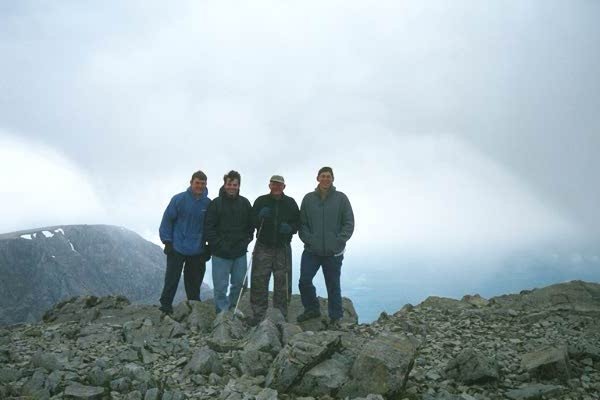
Angie and I would get married that summer. All of my colleagues came to Main Street United Methodist in Kokomo on August 1. I also gave a paper that summer at St. Andrews in Scotland. I went over a couple weeks early and hung out in my old stomping grounds in Durham. During that time, I also managed to meet Keith Drury, Jeremy Summers, and Rob Juilliard and climb Ben Nevis, the highest mountain in Great Britain.

Good times! Feel free to contribute your memories or corrections in the comments!

[1] As of August 1, here is the cast of characters in STM.
  • I am Dean. 
  • Brian Bernius and David Vardaman are division chairs (Division of Practical Theology and Division of Religious and Ministerial Studies). Vardaman will likely be interim dean this year as I depart.
  • Keith Springer and Jim Lo are still with us (as is Bonita as secretary). Keith is Christian Education. Jim is Global Ministries (although he was Intercultural Studies when he came back from being Dean of the Chapel in 2015, same year as I came back)
  • Constance Cherry is our worship professor.
  • Steve Horst and Scott Burson are our philosophy professors, although Scott also advises Sports Ministries.
  • Charlie Alcock and Mandy Drury teach Youth Ministries, and Eddy Shigley also chimes in a little, although he is primarily KERN. Stacy Shaw is coming this fall to fill in for Mandy for three years while Mandy is on a grant.
  • Sarah Farmer has just finished her first year in Community Development.
  • Dave Smith has served this year as STM Ambassador, half time teaching, half time out in the churches.
  • Jon Morgan does theology. Miranda Cruz does theology and church history.
  • Elaine Bernius, along with Brian is Old Testament.
  • Norm Wilson, along with Jim Lo, is Global Ministries.
  • Judy (Huffman) Crossman is Pastoral Care and Counseling.
  • David Ward (former Dean) is Homiletics.  
[2] I remember Mark Smith, Mark Demichael, Cindy Gunsalus, Suzanne Galer being in my "freshman class" that year as well, along with Melanie Kierstead, of course. Doug Daugherty and Tom Lehman were in that group as well.

[3] Joe was a very dynamic and entrepreneurial fellow. He set up a program called "LifeGrow" that involved a lot of VHS tapes of lectures covering the gamut of ministerial training. I remember the tapes being in a storage room. I think they were eventually sold to FLAME.

[4] I have a hard time remembering the lay out of Noggle when I came, although writing this has brought some aspects back into mind. Here is today's sketch:

Friday, August 02, 2019

1997 - The Year I Came to Indiana Wesleyan

It is now public that I am going this fall (2019) to Houghton College as Vice President for Planning and Innovation. I believe the Lord has brought together a number of factors beautifully toward this kairos moment in time, and I'm grateful to Dr. Shirley Mullen and the Houghton community for the opportunity.

As I am a hoarder of memories, I would like to record some thoughts on my first years at IWU, as best I can remember. I have already recorded my memories of the years 2009-2015 in Six Years a Dean: Reflections on the Founding of Wesley Seminary. I have made personal notes on 2015-the present. So here are a few memories of my first 12 years at IWU.

1. I finished my doctoral dissertation at the University of Durham, England, in late summer 1996. I was slightly too late for the August graduation, so I would walk in December. My poor father chalked up the money for three plane and train tickets, hotel, etc for us to go. He never complained. As a father I am far more aware and appreciative now for such sacrifices he made than I was then.

I spent the fall substitute teaching in the public schools of Broward County, Florida. In my naivete, I thought the universities would all give me interviews. And once I got an interview, I thought I could wow them into hiring me as a Professor of New Testament. I applied. I got no interviews. I substitute taught.

It was not a fun year. I would get a call in the morning perhaps at 5:30 or 6:00am. I would go to some school--usually a middle school. I inspired no fear. The students wouldn't listen. They wouldn't do what they were supposed to do. One day in Kindergarten music was horrible. They were all over the room and certainly not watching a movie. One day in a middle school portable a student threatened to go get a gun. He was suspended but my attempt to hold him to keep him from leaving before the bell rang triggered the escalation. In one portable for a half day, they were so loud after the teacher left, even shouting at the top of my lungs I couldn't even get out the assignment.

2. [However, there were a couple interesting moments that year to interrupt the monotony. The most memorable was when my friend Bill Patrick invited me to speak at a Bible study at his Methodist church in Winter Park. Mr. Rogers used to sun at the pool at Rollins College, where Bill adjuncted a course and was an alumnus. He invited Mr. Rogers to come hear me.

So--amazingly--I picked up Mr. Rogers in my dad's Chevy Citation and drove him to the Bible study. He even wrote a letter to one of the Board of Trustees at Princeton, suggesting they hire me! Obviously nothing came of that. :-)

In another typical Schenck moment, Bill and I drove way out of the way to Atlanta on our way to the Society of Biblical Literature (SBL) meeting in San Antonio. A friend from SWU who worked there invited me to speak to his Bible study there. Bill's favorite moment was when a quite astonishingly good looking blonde woman came up to me after the study and told me that she felt like "there is a little theologian in me wanting to get out." :-) ]

3. I received a call or email from Kerry Kind at some point. Liberia was recovering from civil war. The missionaries had evacuated some time before. They wanted to give them some sense that the church was still with them. I was single. Kerry had long wondered, especially given the fact that my sister Juanita had been a missionary to the Philippines, that I might have some future on the mission field. They had even approached me in England after David Wright and his family had left Birmingham. Might I be the coordinator in England for the missions department of TWC?

Liberia became Sierra Leone. Liberia's infrastructure was still too decimated for me to go. But I could go teach at Freetown at the Bible College at Jui. I flew out mid-January, returned mid-March. Less than a month after I left the rebels would overrun Freetown. Those days that followed were dark days for the country. In addition to the many murders there were the gratuitous amputations and removal of children from the womb.

In those two months before the height of the crisis, I would teach. I had some future leaders in my classes--communication, historical books, I think Paul's epistles. Usman Fornah was the one that stands out the most in my mind. I also came to know Abu Conteh and Warren Fornah.

Those were days of fear for me. Every night I watched the lights out my back window of cars coming from up country, wondering if there were rebels secretly among them. I feared the cobras and mombas. They had burned off the ground behind the house in which I stayed to keep them away. I was amused by the cockroaches, ants, and spiders.

One evening I was reading (it was hit and miss whether there would be electricity. They would run generators till 10pm if not) and killed a cockroach )which I knew well from Florida) in the front living space. I then watched a trail of ants from the front door fight with a trail of ants from the back door tug of war over the body. They broke it in half and both got their fill.

So a few days later I killed a cockroach in the kitchen. With a smile, I left it, knowing the ants would take care of it. Sure enough, there was no trace of it at all in the morning.

4. I did not mean to write so much about Sierra Leone. [1] There were two Seventh Day Adventist missionaries in Freetown at the Wesleyan house who hosted me on some weekends. We were some of very few missionaries in the country. The former ones had been airlifted out in the first half of the crisis. The weekend they were going to take me up country to Makeni, the rebels went back into action, and I would never make it up country.

I did not have a lot of money, I think $200 for my time there. In those days I found it difficult to tell anyone no. I gave one Wesleyan pastor $50 to buy a sewing machine. I paid another woman to cook lunches for me to get the experience of SL food and to help her. Let's just say I didn't find goat meat particularly desirable and quickly shifted to food without meat. Cassava was good, although I guess has cyanide in it. I remember a few years later when a number of children in a school in the Philippines, I think in Mindanao, died because it wasn't prepared correctly.

I was a bit shell-shocked from all the requests for help. I was afraid I would run out or have an emergency need I had not saved enough for. I remember flinching when a boy asked me for money at the airport. I was relieved when the plane's wheels left the ground--no more asking.

5. I had spoken to my England friends David Fox and Rachel Leonard about meeting at the Champs Elysees at the Arc de Triomphe at noon on the day I would return from Africa. My plane landed in Brussels and I must have scheduled a layover of a couple days. Again, this must surely have involved some of my dad's money, athough I had been working in the public schools. Surely he must have given me a credit card.

I arrived in Brussels and rented a car. I drove to Paris. I was there at the Arc de Triomphe. I don't know how long I waited. Probably not too much more than an hour. What should I do? They were not there. It wasn't a sure thing, just one of those "if you're there" things. There were no cell phones.

Tubingen it is. In spring of 1995 had spent two months in Tubingen in the kellar of Frau Michel, Otto Michel's wife. I had friends there--Christoph Lorentz, Reinhard Schmolz, Gottfriend Eberspeicher. It took almost all day but I got there by evening. The next day I was able to find them and spend time with them. Then it was time to drive back to Belgium. I went through Luxembourg so I could say I'd been there.

I believe it was on that trip that a man approached me at a rest park asking for a ride. It was against my desires but again, I had difficulty saying no. We conversed in German for a little while. My German was not excellent, but I jokingly would say that I was fluent in "meeting new people" conversations. It was almost an hour into the trip, I think, that we both realized that neither of us was actually German. I think he was Danish.

6. I had also arranged to make a stop in Indiana on the trip home. In late March I somehow managed to get to Elwood, Indiana, where I met with Bud Bence at a Jim Dandy that is long since gone. He was the chair of the Division of Religion and Philosophy. There was an open position in New Testament. Someone, perhaps Kerry Kind, had told him about me.

It was a feeling out conversation. Bud had been Dean at Houghton during a crisis involving a professor there who, like me, had studied with Jimmy Dunn. He was concerned that I would lead to similar conflict at IWU. He asked me questions about inerrancy and such. I don't remember the exact contents of the conversation.

He has referenced the lunch from time. He has mentioned me being honest about my own questions. It seemed he was both cautious and yet interested in me. I could tell in his mind that hiring me would be a risk. Once bitten, twice shy.

I also remember him saying that they tried to hire "thoroughbreds." That is, he liked to hire people who could teach a variety of courses, not just individuals who had a narrow specialization in just one subject. I of course liked that. I would almost teach anything if I were allowed.

7. He must have been enough relieved by our conversation that the Division brought me back up for an interview. By this time I was very happy and grateful to have an interview. I had no real desire to move to Indiana in general, although it was the state of my birth and family history. I had passed on IWU for college, although Tom Sloan had done his best to recruit me. I frankly did not think much of it academically. We had all joked when Barnes renamed it a "university."

I remember presenting on Paul's background in Judaism. I had recently read Bruce Malina and Jerome Neyrey's Portraits of Paul (1996). That was one advantage of Sierra Leone--reading. I had read most of N. T. Wright's The New Testament and the People of God there. I remember Bud asking me a great question--if circumcision was how men converted to Judaism, how did women convert. I remember fumbling around for an answer--by marrying a Jewish man, for example.

I never felt like I thought well on my feet for these sorts of interviews. They were always a great challenge. Over time I have built up a repertoire of opinions and experience that make such conversations easier. But I still often feel that "on the spot" struggle when I appear before committees over curricula and such.

The interview proper took place at the Hostess House over lunch. I remember a couple questions Keith Drury asked. One carefully had to do with homosexuality, since I was single at the time. The other had to do with diversity, although that word wasn't used. If there were another candidate who had roughly the same qualifications as I did but was a woman, who would I hire? I said I would hire the woman. And of course they did. :-)

I also met with President Barnes, the final interview moment in the process. One of the first things he said was, "Now your father has certain questions about how we fund raise?" I smiled and said, "No, that would be my uncle Eugene." Uncle Eugene was known for giving generously to many causes. He also had that Schenck impulse to critique things.

I remember a strange encounter also with the former Chair, who had just stepped down. He didn't participate in the interviews but I ran into him sitting in the dark (as I recall) in a small office in the middle of the suite downstairs. He said he voted for me, or some such. I knew of him from a seminary friend who had done the MA with him, Glenn McGrady. Glenn has since passed, but he had such self-confidence after studying preaching with him. "See this table." What was funny was that while Glenn had a heart of gold, I really did not think him a likely minister.

8. One day not to long thereafter I remember getting a call during supper. I remember going to the kitchen to talk to Bud Bence on the phone. Duane Thompson had decided to retire. He had also been Division Chair at some point in the past but was mostly a philosophy professor. They weren't sure whether they would move forward with philosophy as a requirement or not but needed someone to cover philosophy at least for the following year. Was I interested?

You bet I was. I loved philosophy, even if I wasn't really qualified to teach it. It was just a one year contract. I sensed they were testing me, to see if I would fit or was a trouble-maker. I was over the moon to have a job.

[1] Here are some other interesting tidbits of my time in Sierra Leone:
  • I found out after I left that one of the key workers for the Wesleyan Church in Freetown secretly had another wife up country. Apparently, the issue of polygamy was still alive and well. 
  • Interesting conversations on female circumcision. One person told me that most all of the women I would see, even in the church, would be circumcised. Not sure I believe him. There was a ceremony one night I heard moving further down the Jui peninsula that may have been a female circumcision ceremony.
  • I had three offers of marriage while I was there, two through an intermediary. One uncle told me that "If an American woman marries an African woman, that would not work well at all. But for an American man to marry an African woman is a dream.
  • The heat was devastating for running. I ran a little on the main road with a young man who put me to shame. Was trying to run three but very difficult.
  • There was a sports day. I ran the two mile race for one group. I was in last for most of the race. Someone on my team who had never run before had lapped me. But then he suddenly veered to the side and threw himself on the ground. At least I beat him. I think they ridiculed him for losing to me. :-) 
  • the churches and class, sermon illustrations about resuscitation versus resurrection, shaming into conversion story, evangelism in Freetown, paradigm shifts about civilization, one meal a day for most, Krio, Timne, and class. Easter Monday on the beach and sunburn, "I the God do not change," having fun with planes, airports as liminal zones

Sunday, July 14, 2019

Sermon Starters: Moments of Choice

Date: July 14, 2019
Location: Silver Lake Wesleyan Camp

Introduction
  • The movie Casablanca. The writers themselves didn't know how it was going to end. Will Rick go off with Ilsa? (probably not because of the censors) Will he get arrested by Renault? 
  • [I've dabbled enough with novel writing to recognize that story lines end up taking on a life of their own. The characters--if they are created well--take o.n a life of their own. It's almost as if they come to have free will.]
  • We get to the critical moment. Rick has killed a Nazi. What will Renault do?
  • Life is full of moments of choice, and it is then that the strength of our faith is most demonstrated. Sometimes we ourselves don't know if we will make the right choice, but God is ever faithful--we can! And there is forgiveness if we truly repent of any failure.
  • Text: Joshua 24:1-7, 11, 13-15
  • Israel has not always made the right choice. There was that calf thing. There was that forty years in the desert thing. But they have finally made it into the Promised Land. They have conquered Jericho and possessed the land.
  • Who will they serve? Joshua isn't optimistic, but he makes his choice clear. They also make the right choice. "We will serve the LORD!"
1. We all have a lifetime decision to make.
  • Have you ever really thought about what a God is? Not like Loki in Avengers. I've been treated very nicely this week. What if Justin Trudeau was visiting here? Even if you don't like him, how would he be treated if he visited camp? In the States, what if President Trump came to your church (he did one in Virginia)? They treated him with respect regardless of their politics.
  • God is beyond anything we can compare. He is not someone we can be neutral about. At some point, we pick a side. Are we going to live for ourselves or for something greater? Are we going to live for good and others or for ourselves? Are we going to live for truth or for what suits me?
  • Most of us here have already made a declaration of our allegiance to God over all else--over ourselves, over our countries, over our families. And of course this choice benefits us, our countries, and our families. We often declare this choice at our baptism.
  • Indiana Jones and the Holy Grail - "It's time to decide what you believe."
  • Perhaps there are some who at some moment come to realize they have passed from death to life but they cannot tell you exactly when it happened (Wesley used the analogy of dying for this). But your allegiance to God is clear enough now.
  • Are there individuals who are committed to God but don't fully understand? God knows.
  • The Parable of the Prodigal Son makes it clear that you can always come back if you have gone astray in your allegiance. The Father will welcome you back with open arms, running out to meet you.
2. We have a daily decision to make.
  • Our choice for God is an eternal choice. Imagine if you got married and then said to your spouse, "Well, that was a nice ceremony. See ya!" Choosing God is like marrying Christ. He'd like to see you every once and a while!
  • Hebrews 3:13; 4:1, 7, 11 - we need to enter into the promised land every day called today
  • Running - you don't run a race if you haven't been training
  • Creating paths in our psyches - deciding where the sidewalks should go at IWU
  • "Motion brings emotion."
  • Ways to create paths - daily prayer, daily Scripture, weekly worship, communion...
  • Don't think of these as duties (Amy Farrah Fowler and God taking attendance) but as part of our marriage relationship with Christ
3. We have moment by moment decisions to make.
  • What really sparked this message. Twix commercial. Sometimes I rehearse conversations. It's not always pretty. (Beware of Matthew 5) Emails you receive. Maybe something on Facebook. Maybe watching media in some form.
  • We are often faced with a choice--how are we going to react to something?
  • James 1:13-15 - temptation is not yet sin
  • Harry Potter and Sedrick Diggery - "For a moment there I thought you weren't going to save me." "For I moment there I didn't think so either."
Some suggestions when you are tempted to make the wrong choice:
  • press pause - don't respond immediately (delay on email, come back to Facebook later (a soft answer turns away wrath)
  • remove yourself from the situation (WS, KD)
  • pray
  • listen to that gnawing feeling inside (JD)
  • Seek the counsel of others (and don't be like Ahab) 
  • Train for that moment
Conclusion
  • Are you going to show up when the moment comes?
  • Illustration