Sunday, August 06, 2017

Seminary CM8: Global Christianity

This is the eighth post on the Contexts of Ministry in my Seminary in a Nutshell series. See the bottom for the previous posts in this unit, "The Person and Contexts of a Minister." I have completed one other unit in this series,The Pastor as Leader.
___________________
1. When we founded Wesley Seminary in 2009, one of the books students read in the second class at that time, Cultural Contexts of Ministry, was Philip Jenkins' The Next Christendom. The purpose of this reading was to give students a sense of the shifting demographics of Christianity in the world. In particular, it was to give these ministers a strong sense of the shift of Christianity from what used to be called the "first world," the so called "Western" world, to what we might now call the "two-thirds" world.

Perhaps we should not assume that the background of our current situation is known to any degree among ministers in training. Beginning in the late 1400s, Europe began colonizing the rest of the world, looking for gold and other items of value that they might then sell back in Europe. The "New World" was discovered by Europe as Christopher Columbus sought to find a shorter route to the East Indies.

Some of the precious goods that were imported from Africa were slaves. The slave trade begins and black as a race is born. Before that point, you had distinct African people groups. Now, Europeans come to dub all Africans as black and, thus by contrast, dominant Europeans become "white," another new category.

2. Spain will conquer what becomes known as Latin America, from present day Mexico down to the tip of South America. The Portuguese will take what is now Brazil. The French, Spanish, British, and Dutch will fight over North America until first the British prevail. Then the French will eventually sell out. Finally the new States will push Mexico to its current boundaries.

In Sub-Saharan Africa the French, the Dutch, and the British will parcel up the land. After World War I, the British will watch over the Middle East, as they had already what is now India and Pakistan. The French, Spanish, and British will dabble in Asia, with the British taking the continent of Australia, the French being in Vietnam, and the Spanish in the Philippines.

3. In the twentieth century, these European powers, these "colonial powers" will slowly withdraw from these lands. They have left their traces in the languages that remain. All of Latin America speaks primarily Spanish or Portuguese. English is a predominant language in India and its surrounding countries. Various countries in Africa speak either French or English.

The relationship these European colonizers took to the peoples of these lands was that of master to subservient, superior to inferior. This colonization brought missionaries to these lands as well. Many of them will become Christian lands at least in name. These missionaries had little or no training. No doubt they came largely unable to distinguish the cultural aspects of their faith from its kingdom core. No doubt many if not most of them came with the same sense of superiority than the political colonizers brought with them.

So these missionaries also served to colonize these lands with Western culture, this term itself a sort of construct for the culture of Europe. They came with "benevolent" intent but probably did not, for the most part, view the indigenous peoples as equals in the sight of God. For most of them, these peoples were "poor," "unfortunate" types. Even in the United States in the days before and after the Civil War, few of those in the North actually viewed the slaves as equal individuals created in the image of God. They might "help" those poor folk but most were not looking to make them equal.

4. The language of these days found itself in a time when the industrialized world was called the "first world." Then these largely unindustrialized, colonized lands, including pretty much all of the southern hemisphere, were called the "third" world (cf. Bandung conference of 1955, p.69). The shift to refer to these lands as the "two-thirds world" shows the dawning awareness that the vast majority of the world is not Europe, North America, or Russia.

In the 1970s, my own church, The Wesleyan Church, made a move that I thought at the time was the right move to make morally. Rather than have the rest of the Wesleyan church world be subservient to North America in our general conference, why not empower them to have their own general conferences? Then all of these general conferences would come as equals to the table in a Wesleyan World Fellowship.

The first such conference to break away from North America was the Caribbean, then the Philippines. Canada began the process of breaking away this past year (2016) and Australia has been at least partially separate for five years, I believe. These last two seem to indicate that the principle is sound and in good faith. I will not try to parse the moral complexities of the sense that other general conferences should be financially self-supporting and that this should be the goal of all domains outside North America.

If the motives of The Wesleyan Church (TWC) were mostly pure in making this distinction, the situation is now much more complex in relation to a church like the United Methodists. The UM church never made the kind of separation that TWC made in the 70s. When TWC made the distinction, there seemed to be a genuine sense of empowerment and enabling.

But the situation has changed, as Jenkins' book indicates. Christianity is rising in the two-thirds world much more quickly than in North America. The "global south," as it is sometimes referred to, will eventually have more voting power in the UM church than the North American church. Already in the Episcopal fellowship, Anglicans from Africa are increasingly marginalizing American Episcopal congregations that support the ordination and appointment of practicing gay ministers.

The UM church has been facing the same struggle this decade. If I read the situation correctly, the bishops of the UM church in general seem to support the ordination of practicing gay ministers. The majority of US congregations probably favor unity over schism over this issue. A sizable minority of US ministers view this issue as a "make or break" one. That is to say, if the church in the end ordains and appoints practicing gay ministers, then they will break away from the church.

Until this most recent general conference (2016), I had assumed that a split would involve the conservatives leaving. But the rise of the two-thirds world within the UM church suggests that, if a split delays long enough, the conservatives will eventually have the majority and it would be those in favor of practicing gay ministers who would more likely be forced to leave.

An attempt to separate global Methodism administratively from the North American church, much as the Wesleyans did in the 70s, failed this past UM general conference.

5. So what insights might we gain from Jenkins' book? Let me give quotes and comments from the book that have stood out to me:

Demographics
  • "In 2050, 72 percent of Christians will live in Africa, Asia, and Latin America, and a sizable share of the remainder will have roots in one or more of those continents" (xi).
  • "Over the last century, the center of gravity in the Christian world has shifted inexorably away from Europe, southward, to Africa and Latin America, and eastward, toward Asia" (1).
  • "By 2050 only about one-fifth of the world's 3.2 billion Christians will be non-Hispanic whites" (3).
  • "Far from Islam being the world's largest religion by 2020... Christianity should still have a substantial lead and will maintain its position for the foreseeable future" (6).
  • "Members of a Southern-dominated church are likely to be among the poorer people on the planet" (7).
  • "There is no single Southern Christianity" (8).
  • "Liberal Protestantism has never represented a mainstream of Christianity, or even a majority, and as time goes on, the relative significance of that tradition will decline even further" (11).
  • "Conservative theological or moral stances often accompany quite progressive or radical economic views" (19)
  • Christianity in the global south often has a strongly charismatic flavor and sometimes focuses on the potential economic prosperity of believers.
  • "Almost one Christian in five worldwide is neither Protestant, nor Catholic, nor Anglican, nor Orthodox" (76). Note--he is not including Pentecostal under Protestant.
  • The number of Chinese Christians is currently 65-70 million, about 5% of the population (88).
  • India has more Christians than most European nations (91).
  • "By 2050, six of the world's twenty most populous nations will be on the African continent" (107)
  • By 2050, eight nations could each have a hundred million Christians or more... only the United States is from what is presently considered the advanced industrial world. 
  • These countries are USA (estimated to have 350 million Christians in 2050), Brazil (234 million), Philippines (162), Ethiopia (160), Congo (150), Mexico (130), Nigeria (127), Uganda (106), China (85), Russia (70), Germany (52). See p.113.
  • "The number of African Christians in 2050 will be almost twice as large as the total figure for all the Christians who were alive anywhere on the planet back in 1900" (113).
  • "Most of the global population growth in the coming decades will be urban" (116).
  • Most of the growth in Christianity that will take place in the United States and Europe in the coming decades will be a function of global Christianity. That is to say, it will not be among "white" American Christians. 
  • "Perhaps three-quarters of Arab Americans are in fact Christian" (133).
At this point I might mention that Jenkins is not asking whether or not these are truly Christians. That is to say, he is counting what we might call nominal Christians. For example, he would count a Mormon as a Christian in his statistics. Who is truly a Christian is of course a matter for God to decide (also see next post).

It may be uncomfortable for American Christians to come to grips with the approaching loss of power within the trajectory of Christendom. The election of Trump was arguably just one sign, at least in part, of one section of white America having difficulty coming to grips with a dominance slowly and inevitably slipping away (think Pennsylvania, Ohio, and Wisconsin). This struggle will likely continue for the next few decades in the US until we reach some kind of racial equilibrium.

Another observation is that these shifts are not necessarily about truth. The seemingly inevitable cycle of "liberal" Christianity's demise says nothing of whether it is right or wrong on this or that point. In the same way, the coming dominance of two-thirds world Christianity only speaks of numbers and power, not of correctness. One of the observations Jenkins makes repeatedly is that many of the theologies emerging from Africa and South America are not entirely "orthodox" in the historic sense (e.g., "African Independent Churches" or AICs--66-68).

So North American Christian conservatives are happy to have the southern hemisphere support them on a number of theological struggles, but they may be uncomfortable with the progressive social stances that may also come in force. For example, "liberation theology" has had a significant foothold in Latin America, which advocates at the very least economic liberation and at times political revolution. These socialist and at times communist flavored values will be as distasteful to American conservatives as the southern position is appealing on the ordination of practicing gay ministers.

One take-away I have is that the current shift in dominance is likely to make all of us from the former hegemony uncomfortable.

6. The Situation Past and Present
  • "The whole idea of 'Western Christianity' distorts the true pattern of the religion's development over time" (22).
  • The church of Ethiopia today claims some 25 million members, after lengthy conflicts with Muslims and Marxists, roughly the number of all the Methodist related denominations in North America (26).
  • Had the Mongul invaders, with a Christian queen, have defeated the Turks in Palestine in the 1260s, much of the Middle East might be Christian today (34).
  • Christians have until recently had a significant presence in the Middle East despite Muslim dominance. Ironically, a large percentage of Palestinians have historically been Christian (as opposed to Jews). There has been a significant minority of Syrian Christians in Syria and Chaldean Christians in Iraq. Coptic Christians have been a significant presence in Egypt. 
  • British and American actions in the Middle East over the last century have inadvertently resulted in forces that have brought persecution and diaspora to these groups. In Palestine, for example, American Christians have strongly supported the Israeli dominance over the Palestinians, even though far more Palestinians have been Christian.
  • During the colonial era, Westerners tried to impose their own ideas of Christianity as it should be to the world. Gradually, indigenous peoples moved beyond the colonial matrix. Finally they adapt and incorporate native ways and form wholly new churches (70). This of course is what happened when Christianity came to northern Europe as well.
A central take-away from these insights is the way evangelical Christians have often blindly participated in political forces that have, unintentionally, had harmful repercussions to Christians in the Middle East. America's blind support of Israel has hurt Christianity among Palestinian, Egyptian, Syrian, and Iraqis. The blind assumption that all Arabs or Middle Easterners are Muslim has only made things more difficult for Arab and Middle Eastern Christians, whose Christianity is far more ancient than American Christianity.

Another potentially sobering possibility is that what we consider orthodoxy may have elements of European (as opposed to the pre-Constantinian Christian) culture. A theological construct of which I am very fond--consensus Christianity--is vulnerable to the charge that the consensus of which we speak significantly involves the culture of the European Middle Ages. Are there elements that are similar to when holiness missionaries to Native Americans had them wear buns and skirts, while stopping all forms of dancing?

7. Looking to the Future
Some final quotes:
  • "As Christianity becomes increasingly Southern, it cannot fail to absorb the habits and thought-worlds of the regions in which it is strongest" (140). It has always done this, and that is okay. "London's St. Paul's Cathedral almost certainly stands on the site of an ancient pagan structure" (138).
  • "Hispanic theology is acutely concerned with issues of liberation, suffering, and social justice, while matters of race are also paramount" (144).
  • "A black or brown Mary would be a powerfully appropriate symbol for the emerging Southern Christendom" (147).
  • "The practice of healing is one of the strongest themes unifying the newer Southern churches, both mainstream and independent, and perhaps their strongest selling point for their congregations" (157).
  • Many Southern churches appropriate the OT more directly and literally than the West has come to do (this was also true of frontier churches in the US in the 1800s, as we see in traditions about the Sabbath, circumcision, tithing, and verses relating to appearance).
  • Churches are fundamentalist and charismatic by nature (169).
  • "The greatest change from present assumptions is likely to involve the Enlightenment-derived assumption that religion should be segregated into a separate sphere of life, distinct from everyday reality" (171).
  • Politics and religion tend to align in the two-thirds world. Of course this happens in the US as well.
  • "Religious loyalties are at the root of many of the world's ongoing civil wars" (201).
  • Catholicism is not so much waning in the southern hemisphere as changing. For example, charismatic and Pentecostal elements are on the rise.
  • Immigrant churches are on the rise in the US and Europe, and two-thirds world countries are increasingly sending missionaries to Western lands. 
  • By 2050, it seems likely that "whites" will make up less than half of Americans. Over half may be Hispanic, a quarter black. Asians not quite a quarter.
Jenkins is a sociologist of religion. He is not saying what should happen, only what he thinks has and is going to happen. What this means is that we who are in the church need to engage a dialog with "the other" as equal participants. This must not be a dialog of a supposedly "superior" Western Christian "schooling" the "inferior" global Christian. It should be a dialectic. Each side raises concerns and makes points. A synthesis will emerge over time. I believe this is also the most profitable way to move forward whenever any two or or more groups are in tension or conflict.
The alignment of political party with religion is something that European Christianity and indeed world Christianity has born the scars. History has emphatically shown the need to align Christianity with principles rather than political party. When Christians persecute Christians, something is wrong. Similarly, we can debate whether the strong alignment of American evangelical Christianity with the Republican party is in the end a healthy situation for American Christianity in general.

8. For the moment, he notes that Christianity is alive and well among the poor and persecuted (275), and the truly persecuted do not live in the white portions of North America.

No doubt the future will throw some wrenches in these prognostications. As G. K. Chesterton once said, future humanity listens respectfully to prophets and prognosticators, then goes on to do something different after they are nicely buried. Jenkins is convinced that the shift of Christianity to the southern hemisphere is taking place. He is less willing to commit to what that will end up looking like.

The currents of history are always alterable, especially through violence. For all we know, God could let the world destroy itself before the next election.
Next Sunday: Culture 9: The Rise of the Nones

The Calling of a Minister
The Person of a Pastor
Contexts of Ministry

Saturday, August 05, 2017

Rovelli 4: Time Does Not Exist

This is my fourth post on Carlo Rovelli's new book, Reality Is Not What It Seems. The first three posts were:
1. Chapter 7 is getting closer to theology. I have always been sympathetic to the medieval view that God is outside time. God immanent goes through time with us. God transcendent sees all of time in an eternal now. This construct provides a helpful way around the "Does omniscience imply determinism" debate.

I had the thought while reading this chapter, "God is quantumly entangled with the entirety of his creation." Quantum entanglement is the sense that when two paired particles go their separate way, their states remain connected. In Quantum Gravity, Smolin suggests that this connection can apply to particles inside and outside a black hole.

So I was playfully musing of God knowing every quanta of the universe from its connectness with him at the moment of creation. It's not a suggestion or completely satisfying. After all, this musing does not clearly relate to the future. It would only suggest an exhaustive knowledge of the present and the past.

2. One of the implications of general relativity is that "every object has its own time, running at a pace determined by the local gravitational field" (178). If I am traveling close to the speed of light and you are not, I will age much slower than you will. If you live on a planet with a much greater gravitational field than earth, you will age more slowly than me back on earth. In fact, someone who spends their whole life in Tibet will be a fraction of a second older than me, living my whole life at the Dead Sea, even if we were born at the same exact moment somewhere.

"Time" does not pass at the same rate everywhere.

One thing Rovelli has already mentioned is that, in some of the fundamental quantum gravity equations (e.g., Wheeler-DeWitt), there is no time variable. How is that possible? It gets back to a principle he has stated in his chapter on quantum mechanics. Reality is relational.

Quanta of gravity do not change "in time." Time is simply a counting of the interactions of quanta of gravity. The world is not something that changes "in time," for time does not exist. There is only process after process. "There is no longer space that 'contains' the world, and no longer time 'during the course of which' events occur" (183).

I am hoping I will have a better sense of what I am saying by the end of the book. :-)

3. So an event does not take place in spacetime. Rather, spacetime is part of the event. The event is a process with an initial and final state. And there is a boundary for the event.

"If quantum space has the structure of a spin network, what structure will spacetime have?" (186). Spacetime is the history of a spin network. This history of a spin network is apparently what Loop Quantum Gravity (LQG) physicists call "spinfoam."

I don't really like this word. The idea seems to be that the area of the node foams up to the beach of the line between nodes. And that beach is a spin line. I'm sure I'm massacring it.

"To compute the probability of a process, one must sum up over all the possible spinfoams within the box that have the same boundary in the process. The boundary of a spinfoam is a spin network and the matter on it" (187). This is what Feynman did to calculate the probability of a particle's trajectory.

4. So to sum up the chapter. "Space is a spin network whose nodes represent its elementary grains [of gravity], and whose links describe their proximity relations" (192). What we call spacetime is the transformation of these spin networks into and apart from one another, and the history of these spin networks is called "spinfoam."

So all reality is variations on quantum fields, fields one on top of the other. Another name for these are "covariant" quantum fields. These are, in Rovelli's mind, the fundamental reality that connects spacetime with quantum fields.

More to come...


Friday, August 04, 2017

Rovelli 3: Quanta of Space

This is my third post on Carlo Rovelli's new book, Reality Is Not What It Seems. The first two posts were:
1. This chapter is not long but it is getting at the things I am interested in right now. I re-skimed chapter 10 of Lee Smolin's Three Roads to Quantum Gravity to cross-reference their material. That chapter is called "Knots, Links, and Kinks." I see Smolin's coming out with a new edition.

Because I don't know the math, because they don't fully give the math, it's hard to get more than just an impression from these chapters. But I like the basic theses.

2. We already have the first key truth. Both space and time reduce to quanta. Space is not infinitesimally continuous. Time is not infinitesimally continuous. I like it.

Now here's another biggie. Gravity reduces to quanta, discrete units of gravity. The quanta of gravity are not in space. "They are themselves space" (172). "Quanta of gravity constitute space itself."

Using another picture, space reduces to discrete packets of volume, which we might call "nodes." "Volume is a property of the gravitational field, expressing 'how much gravitational field' there is" (163-64). The imaginary lines between these nodes are called "links," and a whole set of such intersecting lines is called a "graph."

Nodes, Links, and Graph (Rovelli)
3. There is an area associated with the lines between nodes, which is roughly the square of the Planck length mentioned in the previous post (8πL2 times the square root of the spin times one plus the spin, with the spin coming in half integers). When we think of a larger three dimensional volume, the volume is the sum of the volumes of the nodes. Such a volume is a "spin network."

4. After writing all that, there is a danger of thinking that these nodes are space. But Rovelli and Smolin would both want to clarify that, like the electron, it is in the interaction of these gravitational quanta that space exists. Space is not in the node nor is the node space. Space is what happens when the nodes interact, if I understand correctly.

Adam and the Genome 8: 12 Theses about Genesis

I'm reading the book, Adam and the Genome: Reading Scripture after Genetic Science, by Scot McKnight and Dennis Venema.

Previous posts
Personal Preface
Forward and Introduction
1. Evolution as a Scientific Theory
2. Genomes as Language, Genomes as Books
3. Adam's Last Stand?
4. Intelligent Design?
5. Four Principles for Bible Reading

Chapter 6
1. Chapter 6 is titled, "Adam and Eve of Genesis in Their Context: Twelve Theses." You find different angles on things out there, sometimes they come at things from different angles, but they are working toward the same destination. McKnight's angle in this chapter is:

"The Bible's opening chapter is an ancient Near Eastern form of science" (111). But his point is not thereby to dismiss it. His point is to understand it in dialog with other ANE (Ancient Near Eastern) creation stories. This approach, he argues, is most respectful of the text because this is the way of reading the Genesis text that reads it for what it actually meant in context. "These [ANE] texts express the kinds of ideas 'in the air' when Genesis 1 and 2 were drafted" (113).

McKnight has a hermeneutic that says, we read biblical texts both within and as critiques of cultural context. Or as I have put it, revelation begins with where a culture is, but it doesn't stay there. God meets us where we are, but he doesn't leave us there. So we should expect the biblical creation stories both to resemble and yet to push against the other ANE creation stories.

2. What are these ANE creation stories:
  • Enuma Elish -- Marduk creates humanity so that the gods can rest and stop working
  • Gilgamesh -- the Babylonian flood story
  • Atrahasis -- A god creates humans from clay and his own flesh and blood, so that humanity can work for the gods
  • Assur story -- Sumerian story, gods give birth from the blood of gods
McKnight discusses both similarities between these stories and Genesis but, more importantly, he notes key differences. For example, God is the unopposed creator in Genesis, while none of the gods in the other creation stories are completely in control.  It is here that we get his "twelve theses" in this chapter.

I might add that he is bracketing in this chapter concerns about whether Adam and Eve are "historical" or "fictional." He is treating them as they appear in the text of Genesis without addressing these questions now. He is exploring the "literary Adam and Eve" (118).

The Twelve Theses (in my words)
1. There is one God, the creator who is outside the cosmos.

He is not part of the universe but created it. Hear Bill Arnold of Asbury fame: "Ancient religion was polytheistic, mythological, and anthropomorphic... while Genesis 1 is monotheistic, scornful of mythology, and engages in anthropomorphism only as figures of speech" (119). Also, McKnight adds, God creates through the Son of God, who is his Wisdom.

2. Adam and Eve are not the result of cosmic battle, but of God's design.

3. God orders creation into a temple.

Jon Levenson writes, "The concern of the creation theology is not creatio ex nihilo, but the establishment of a benevolent and life-sustaining order" (124). McKnight writes, "To 'rest' in that world is to enter into a temple" (126). "The earth is not designed as a scene of conflict but a scene of worship" (127).

I'm not as clear on the temple/worship theme being present myself.

4. All humans are made in God's image.

Humans "are called by God to mediate God's power and authority in the world" (129). I'm less clear about the intention of statement: "Humans are not given the responsibility to rule other humans but to rule creation" (131).

5. Humans are distinct from the rest of creation.

6. Humans are gendered for procreation and are tasked with governing and nurturing the earth.

I wouldn't want to take this statement too far: "They image God whenever each separately or whenever both together rule, subdue, or cause any element of creation to flourish in God's design for it" (133). McKnight warns about both extreme individualism (Thomas Paine) and collectivism (Mao Tse-Tung).

7. Humans are called to work the earth.

8. Humans name creatures, showing understanding of them and how they fit and function.

"To name is to know and understand by observation, and then to assign oneself a relationship to and a responsibility for that which is named" (137). Helper is used of God in the OT, he notes, BTW.

9. God gives humans the freedom to grow as well as to disobey him.

McKnight quotes Brueggemann: "In God's garden, there is mutuality and equity. In God's garden now, permeated by distrust, there is control and distortion" (141). McKnight sees this as descriptive of the consequence of sin, not prescriptive of how it should be.

10. Humans are called to undo the curse.

"All humans, male and female, remain images of God" (142). The mission remains.

11. Adam and Eve  represent both Israel and everyone.

"This text is far more about Adam and Eve as Israel than about the historical, biological, and genetic Adam and Eve" (144). It is a foreshadowing of Israel's entrance into the land in Joshua, by many accounts.

12. Adam and Eve are presented as "genealogical" Adam and Eve.

That is to say, the Bible does present Adam and Eve as the genealogical parents of all the people in the Bible.

Thursday, August 03, 2017

Rovelli 2: Spacetime is Quantum

This is my second post on Carlo Rovelli's new book, Reality Is Not What It Seems. The first post was:
1. My book has now been baptized in coffee, but is still readable. I suppose it was inevitable.

We now hit the problem edge of physics in chapter 5. Quantum mechanics works for things that are very small. General relativity works for things that are very big. They contradict each other.

Relativity says that spacetime is curved and continuous. Quantum mechanics says that space is flat and energy is discontinuous.

This contradiction is not a problem unless you are dealing with something that is both very small and yet has tremendous mass. In other words, black holes and the Big Bang.

2. A favorite scientist of Rovelli is clearly the Russian, Matvei Bronštejn, put to death under Stalin in 1938. He apparently suggested before his death that, following Heisenberg's uncertainty principle, the narrowness of location would require great ambiguity in momentum. The energy this would involve at a particular point would be so great as to create a black hole.

The bottom line, Bronštejn suggested that this thought experiment implied a limit to the divisibility of space. The minimum space is around:
This "Planck length" combines the three fundamental constants of nature. "H bar," as it is called, is fundamental to quantum mechanics. C is the speed of light from special relativity. And G is the gravitational constant from general relativity.

3. The next turn in the chapter is to John Wheeler, who coined the phrase black hole. It was not too long ago that many physicists were skeptical about their existence, but now it is overwhelmingly accepted.

Apparently, Wheeler and Bryce DeWitt come up with an equation for the "foaming" of space at the Planck level, the "Wheeler-DeWitt equation." Here I am beyond much acquaintance. What is most curious about the equation is that it does not have a time variable. How do you describe interactions on the most fundamental level of reality without a time component?

There will me more to come on this subject. I have some other sources that I may use to try to triangulate.

4. We are close to the birth of quantum loop gravity, the main contender with string theory for ultimate reality right now. In the late 80s, Abhay Ashtekar simplifies and rewrites the Wheeler-DeWitt equation. Lee Smolin tells the same story from his perspective in Three Roads to Quantum Gravity.

Smolin and a guy named Ted Jacobson find some solutions to this equation. The equation only has solutions when lines "loop" in space. Thus "loop quantum gravity" is born.

More to come...

A Tale of Two Schencks

One of my Dad's cousins sent me an obit for someone who passed away this week in Clinton County at the age of 80. The person's maiden name was Schenck.

That's quite curious, since my great grandfather Schenck lived in Clinton County when he died in 1930. This person was born in 1936 in Clinton County.

                My tree                                                        Their tree
1. Ken Schenck was born to
↓
2. M. Lee Schenck, who was born in 1924
in Boone County, Indiana to
↓                                                                                    This person was born in 1936
                                                                                      in Clinton County, Indiana to
3. Dorsey Schenck, who was born in 1898                          ↓
in Carroll County, Indiana to
↓                                                                                    Arthur A. Schenck, who was born in 1903
                                                                                      in Lebanon, Indiana to
4. Samuel Schenck, who was born in 1871                          ↓
in Montgomery, Indiana to
↓                                                                                     Ethan A. Schenck, who was born in 1854
                                                                                       in Boone, Indiana to
5. Henry Schenck, who was born in 1833                            ↓
in Butler, Ohio to
↓                                                                                     Daniel Schenck, who was born in 1820
                                                                                       in Butler, Ohio to
6. William S. Schenck, who was born in 1804                     ↓
in Monmouth, New Jersey to
↓                                                                                     Samuel Schenck, who was born in 1786
                                                                                       in Monmouth, New Jersey to
7. Garret Koertse Schenck, who was born in 1777               ↓
in Monmouth, New Jersey to
↓                                                                                     John Roelofse Schenck, who was born in 1766
                                                                                       in Monmouth, New Jersey to
8. Courtenius Schenck, who was born in 1751                     ↓
in Monmouth, New Jersey to
↓                                                                                     Roelof Janse Schenck, who was born in 1742
                                                                                       in Monmouth, New Jersey to
9. Garret Koertse Schenck, who was born in 1725               ↓
in Monmouth, New Jersey to
↓                                                                                     Jan Schenck, who was born in 1721
                                                                                       in Monmouth, New Jersey to
10. Kortenius Schenck, who was born in 1702                     ↓
in Monmouth, New Jersey to                                  
↓                                                                                     Roelof Schenck, who was born in 1692
                                                                                       in Flatlands, New York to
                                                                                           ↓

11. Garret Roelofse Schenck, who was born in 1671         Jan Roelofse Schenck, who was born in 1670
in Flatlands, New York to                                                  in Flatlands, New York to
↓                                                                                       ↓
Roelof Martense Schenck
Who emigrated from the Netherlands in 1650

Wednesday, August 02, 2017

Rovelli 1: Relativity and Quantum Mechanics

1. I only discovered Carlo Rovelli this last month. If you have followed my Brownian motion through science books, you will know that I have read parts of several books that have left me feeling rather empty. In the last few years I have started and not quite finished to varying degrees Tegmark's Our Mathematical Universe, Brian Greene's, The Fabric of the Cosmos, Roger Penrose's, The Road to Reality, and most recently, Lee Smolin's, Quantum Gravity. I read all but the last three chapters of Smolin's book last month, and it was he that set me on to Rovelli.

Maybe I'll go back and finish Smolin. He must decrease; Rovelli must increase.

In 2014 over spring break, I discovered The Perfect Theory: A Century of Geniuses and the Battle over General Relativity. It was fantastic. Since then I've been looking for the silver bullet to bring me up to speed on the edge of physics. I'm hoping to meet up with theology at the end. I did a MOOC that was wonderful, From the Big Bang to Dark Energy.

Since then (maybe even before then... I can't remember) I've had in mind a quasi-novel writing project called, "The First Day of Creation." I've been scrambling to read bits and pieces, trying to learn things I've been trying to learn since I was in high school. I've never gotten so far!! Schroedinger's equation is on the bucket list and is probably only a few hours of study away.

I can tell my mind is 50. I can remember how quick my mind used to be. It's depressing. I had coffee with a physics colleague of mine at IWU this week. He's just a little older than me but agreed that he could feel it.

BUT, I've never gotten this far. I've never understood so much. If only I'd have had someone to explain it to myself then!!!

2. I'm not done with Carlo Rovelli's Reality Is Not What It Seems. It came out this year. It is even better than The Perfect Theory. I don't think I've ever read anything so clear on these topics. Maybe it's just because I'm finally hitting a critical mass. I wanted to jot down notes on the first four chapters. They bring the reader up to speed with relativity and quantum mechanics.

It's so clear!! The rest of the book goes on to quantum gravity, the very edge of where physics is.

3.  I was annoyed with chapter 1. Maybe if I hadn't read so much I wouldn't have minded. He went back to Democritus and the ancient atomists. Epicurus, Lucretius. Yes, yes. Get on with it.

The nugget here was on Einstein and Brownian motion. In 1905 Einstein wrote three groundbreaking papers. One of them was on Brownian motion. It verified that matter was made up of atoms, whose vibrations knock a grain around on the surface of water.

4. Chapter two moved on to Newton in the 1600s and Faraday/Maxwell in the 1800s. Yes, yes. I've read most of this stuff before. Newton looks at space and time as the frameworks in which everything else moves. Rovelli at least likes that he subverts Plato and Aristotle. Well I do too. Half the Christian thinkers of the current age are still bemoaning that one.

Faraday and Maxwell come up with the idea of fields. You can act on things at a distance with electromagnetism. Maxwell's equations--on the bucket list and within striking distance.

5. Chapter 3. Finally. We get to relativity. I've given and continue to give some time to it. Sometime this fall I'm scheduled to do a Friday post on it. The post is already started.

One of Einstein's 1905 articles is the one where he announces special relativity to the world. Einstein solves a contradiction in the physics of his day. Normally, if you are on a train moving 40 miles an hour and throw a baseball forward at 30 miles per hour, it will seem to be going 70 miles an hour to me standing in a nearby field.

But it was discovered that the speed of light is 300,000,000 meters/second no matter where it is. If I shine a flashlight in the field, if you shine a flashlight on top of the train, if an ant on the baseball shines a light. No matter which one of us measures my, yours, the ants light speed, it will come out 300,000,000 meters per second.

Einstein's solution was brilliant. Spacetime appears to contract, depending on where you are standing. If you are moving close to the speed of light, you will seem to have shrunk and slowed down to me. And I will seem to have shrunk and slowed down to you.

6. But Einstein's general relativity has been called "the most beautiful of theories." He came out with it in 1915. I have a hunch David Hilbert really beat Einstein by a week, but as a gentleman he let Einstein take the credit. It is highly debated. Hilbert knew the math Einstein needed to finish the theory. Einstein had great difficulty getting his mind around it.

Hilbert said, "Any youngster on the streets of Goettingen understands geometry in four dimensions better than Einstein. And yet it was Einstein who completed the task" (92).

The main idea is that space curves around objects of great mass. Gravity is not a force. It is the curvature of space near a large object like the earth. So we are really simply moving along the curvature of space, not being pulled by the earth.

Rovelli goes on a fun tangent relating to Dante and the geometry of spheres. I kept telling myself. "He's Italian. Of course he's going to connect the story to its Italian connections." And, "man, this guy knows a lot more than physics." :-)

7. Chapter 4 is the best treatment of quantum mechanics I've ever read, and I've tried a number. Then again, I'm hitting a critical mass so it's bound to make more sense than ever.

Rovelli describes quantum mechanics in terms of three fundamentals. First, reality breaks down into quanta. Reality is granular. Energy breaks down into packets of photons. Matter breaks down into packets of fundamental particles like electrons, quarks, and neutrinos.

Again, I have been filling in gaps on the Standard Model these last five years. I read some in Richard Feynman. The confirmation of the Higgs boson has put the icing on the cake of the standard model. Now Rovelli can assume it.

By the way, Einstein's third paper in 1905 showed that, indeed, energy exists in quanta. Although Max Planck in 1900 is often said to be the father of quantum mechanics, he didn't really believe what he was seeing. Einstein again, showed quanta were real.

8. The second fundamental is that reality is indeterminate. This one has taken some time to convince me (Einstein was never convinced). I have disliked Heisenberg and the Copenhagen interpretation of quantum mechanics since my teens. I have a thick book by David Bohm I don't understand but hope one day to read. Like Einstein, he rejected indeterminacy.

But Rovelli has sealed the deal for me. Electrons have no positions until an event happens. This is his third point, the one I don't fully appreciate yet but am beginning to understand. Reality is a matter of events. The way he and Smolin put it is that "reality is relational." I'm sure that's better but let me start with what helps me.

"Quantum mechanics does not describe objects; it describes processes and events that are junction points between processes" (136).

The electron is only a possibility until it bumps into something. Rovelli has a great footnote where he says that Schroedinger's equation is not about reality. It only tells you the probability of where the particle will show up once an event happens. And when that happens, it is always at a point.

9. I'm not doing the chapter justice. I have known the players forever. I touched Dirac's door in Tallahassee in 1983, about a year before he died. But this chapter really moved me forward in understanding what these guys were really doing. How has this taken so long???

Heisenberg describes the appearance of electrons at a particular point as someone walking under lamp posts in the dark in Copenhagen, appearing for an instance under one only to disappear into the dark and then to mysteriously appear under another. Brilliant!

Dirac with Asperger's puts together the math, which I've realized is basically linear algebra, a new item on the bucket list. First we calculate the possible values an aspect of a particle can have ("calculation of the spectrum of a variable"). Then we calculate the probability of each possibility ("calculation of the amplitude of transition"). All those orbits we had to learn in chemistry are the possible solutions to Schroedinger's equation.

Dirac succeeds at combining quantum mechanics with special relativity. The challenge, what Rovelli is up to, is still to combine it with general relativity. That is the rest of the book.

10. Feynman also features in this chapter, connecting another strand I have not yet connected. His path to calculating the probability of a particular path is to add up all the possible paths. "It is as if the electron, in order to go from A to B, passed through all possible trajectories" (133).

11. I want to end with this chart, which is a brilliant encapsulation of the paradigm shifts that have taken place to this point in the book:


More to come...

Monday, July 31, 2017

Paul Novel 4.7: Faith, not Works of Law

continued from last week
____________________
The reaction to the blow-up largely fell along Jew-Gentile lines. There were two love feasts that Sunday evening, one in the home of Menaen with the Jewish believers and another in the home of Menander with the Gentiles. Very few Jews went to Menander's, but Paul was one of them.

Menander was particularly discouraged that Barnabas did not come, but Paul was furious. He at least had enough calm to assure them that it was not because Barnabas actually agreed with James and Peter. "He is just keeping the peace," Paul told them. "He is submitting to authority."

Paul continued. "Barnabas wanted me to tell you all that he does not think you are sexually immoral. He urged me to tell you to be patient because it takes some people longer than others to discern the will of the Holy Spirit. He wants to assure you that Peter is only trying to do what is right and that he loves you in the Lord."

He gave a long word of exhortation that night. "I used to think like Peter and James," he said. "In fact, I believed you Gentiles were so sinful that I would have been defiled the moment I crossed the threshold of this house. I kept the Jewish Law more carefully than any Jew you have met, certainly more than Peter or James. I used to think of Jesus as one of the vilest sinners.

"In fact, at that time Jesus was almost worse to me than a Gentile because, to me, he was encouraging Israel to sin. How would God send the Messiah to restore the kingdom of Israel if we had Jews going around encouraging sin? Jesus spent a lot of time with the sinners of Israel, people like tax collectors and prostitutes.

"But God stopped me in my path, for which I am eternally grateful. I was on my way to Damascus to arrest the disciple Simon. You all know Simon. He spends a lot of time in the more activist currents within Israel. But God appeared to me and showed me that I was actually working against his will.

"You have heard the phrase 'through the faithfulness of Jesus.' It is something they talk about a lot in the Jerusalem church. When they use the phrase, they are talking about how God has chosen to restore the kingdom of Israel through the faithful death of Jesus. The sin of Israel was too great for the temple to atone for it. It was too great for people like me or Barnabas to make up for it.

"But Jesus absorbed the wrath of God toward Israel, like the Maccabean martyrs did not so long ago. His faithfulness brought an end to the wrath of God toward his people. The righteousness of Jesus, I see now, was beyond any righteousness that any of us could provide because he was God's Son. He had no sin.

"All day I've been thinking about that phrase, 'through the faith of Jesus." There is another way to take the phrase in Greek. I've heard some of you say it by mistake. But maybe it is no mistake after all. You all have faith in Jesus, don't you? That's what has made you right with him. It's not these sorts of 'works of Jewish Law' that Peter and James seem so concerned with. We are all put in right standing with God because we have faith in what God has done through Jesus the Christ.

"And when you think of it, I kept the Jewish Law really well. But that was nothing before God. It was like a pile of poop when you put it next to the faithfulness of Jesus. You might say that those sorts of works of Law--food laws, purity laws, whether you are circumcised--are all nothing compared to Christ. You all here tonight have faith that God raised Jesus from the dead. You all have confessed Jesus as your Lord. That is more than enough."


Tuesday, July 25, 2017

21. Conquest by Peace

"Conquest by Peace" is the title of chapter 24 of Konrad Heiden's 1944 book, Der Fuehrer.  See the bottom for previous posts.

1. Make no mistake, there is no love for Hitler in this chapter. But perhaps there was a hint of admiration for the talent of an evil man at one skill. And indeed, although Hitler was presiding over the murder and oppression of swaths of his own people, he managed to calm a nervous world with talk of peace.

One of the most striking comments of Heiden is that Hitler may have even believed himself. We are not looking for the Germanization of the world, he told the world. They did not want war. They needed peace. Hitler agreed with the proposal of US President Roosevelt when he argued that the nations of Europe should only keep a defensive military but do away with offensive weapons like planes, tanks, and such.

Germany only wanted the right of self-determination, the right to truly be German. They did not begrudge the rest of the world its own right to be French or British or Italian or Russia. "Germany does not think of an attack, but of her security" (620), said the new dictator of Germany.

Perhaps Hitler even believed it in the moment. But it was not in his nature. You cannot believe what people like Hitler say. You have to see beyond what they even see of themselves to their true nature and destiny, which is the destruction of all around them.

2. The world wanted to believe Hitler. Perhaps in his more honest moments, he was doing with peace what he did with democracy. Having used democracy to destroy democracy, now he would use peace to destroy peace.

He did not have an army, he said. The SA are not an army, he said. War would not bring the much needed peace to Europe. What would bring peace, according to Hitler, was letting each national entity be itself, and Germany would not begrudge other nationalities from doing the same. "She wants nothing for herself which she is not willing to give others" (621).

"An extraordinary number of people were immediately convinced" (624). Hitler had done it again. He had changed his message to fit the expediency of the moment. "Facts were powerless against the tone of truth in Hitler's speeches" (624). "With his peace speech Hitler had immediately become the most powerful and most widely heard speaker in the world" (625).

"Fate, for a moment at least, put it in his power to say what the world felt" (627). Even President Roosevelt was enthusiastic about Hitler's vision for peace.

3. Meanwhile, parliaments and democracies were fading away all over Europe. Mussolini was already a dictator in Italy. The leader of Poland had slowly taken the role of a dictator. The leader in Austria, in a dispute over the rules of parliament, sent parliament home and never called it back. Only Czechoslovakia remained a democracy, isolated in eastern Europe.

"While incomprehensible and hideous things kept happening in Germany, which foreboded nothing good for the future of the rest of the world, Hitler's policy toward foreign countries was of a suppleness, indeed a compliancy, which should have aroused amazement, except for the fact that people see only what they expect and perceive the new only after it has become customary" (614).

Take-Aways
  • Never trust the word of a madman wanting to lead, even when in his own mind he is speaking truthfully.
  • The rising dictator, still gaining power, can lull his opponents into a self-defeating acquiescence because they do not want to face the need for painful action while it is still possible.
  • People only see what they want to see, until they get used to the new normal, when they then deny that anything is truly wrong. Frogs will deny that the temperature is dangerously rising until they have become used to the boiling water.
Previously on Hitler:

Monday, July 24, 2017

Paul Novel 4.6 Blow-Up at Antioch

continued from last week
____________________
But everything changed when more men arrived from Jerusalem, from James. When they saw that the Christian Jews were eating with Gentiles--indeed that Peter himself was--they took Peter aside.

"What are you doing, Peter?" they asked him. "You are the apostle, the first one to whom our risen Lord appeared! You have to set the tone. You have to be an example for the church because everyone is looking to you as their leader."

They explained to Peter that it was exactly this sort of situation that James had feared. Did Peter know for sure whether the Gentiles he was with were clean? Did he know how the meat had been prepared? Did he know what kind of life they were living?

It all came to a head the next Lord's Day. In the morning, they all met for worship in the morning by the river. But that evening the love feast was to take place at the home of Titus' family. As they were about to disperse for the day's work, Titus' father Menander stood up to remind everyone where the love feast was to be held that day.

At this point Peter stood up and interrupted. "We need to make some changes in the love feasts from here on. Because we who are Jews have to keep the Law, we cannot eat the meal with the God-fearers. And there are too many of you really to meet in only one house anyway. So we who are Jews will be having our love feast at the home of Menaen, while the Gentile believers will continue to meet at the home of Menander."

Paul was completely taken off guard, as were Menander and the other God-fearers. There was an audible murmur among the group. Barnabas, who was standing next to Paul, knew what was about to happen and grabbed Paul by the arm. "Paul, don't say anything publicly. We'll meet with Peter and figure this out. Just let it go for now and we'll get to the bottom of this."

Paul completely ignored him.

"This is hypocrisy!" Paul said loudly. "You do not keep the Law, Peter! You are a hypocrite," Paul said angrily. "I was a Pharisee. I know what it is to keep the Law. You don't keep the Law. Do you tithe your mint or cummin? Why you ate at the house of Mycenas this last Tuesday. You would have these Gentiles become zealous keepers of the Jewish Law when you yourself are not zealous for the Law.

There was another gasp to hear Paul confronting one of the pillars, one of the very disciples of the Lord. Paul then turned to the Gentiles in the group.

"Gentiles, God does not consider us to be in right standing before him because of these works of the Law, things like circumcision, purity laws, Sabbath observance. These works of the Law will not justify anyone before God. God has only made Israel--and now all God's people--finally right again with him again through the faithfulness of Jesus Christ, as I have heard Peter himself preach!"

Saturday, July 22, 2017

9.5 Relationships in Inductive Circuits

This is the fifth week of Module 9, "Relationships of Current, Counter EMF, and Voltage in LR Circuits." These modules are part of the Navy Basic Electricity and Electronics series from the 1970s. The fifth section of this module is titled, "Relationships in Inductive Circuits."

9.1 Rise and Decay of Current and Voltage
9.2 LR Time Constant
9.3 Universal Time Constant Chart
9.4 Inductive Reactance

1. The previous units have set out a number of relationships. For example, the "reactance" of an inductive circuit, the equivalent of its resistance, is found by the equation XL = 2πfL, where f is the frequency of alternating current and L is the inductance.

So we can substitute XL for resistance in the earlier equations.
  • Since E = IR, then E = I * XL
  • Since I = E/R, then I = E/XL
  • Since R=E/I, then XL= E/I
2. In normal circuits, power equals current times voltage, P = EI. Or substituting in for E, P = I2R.

In a purely inductive circuit, power is never consumed, but we can speak of "apparent power." It is symbolized by Pa, and it is measured in volt-amperes (va), not watts.

What happens is that the power is supplied by the AC source, stored for part of the cycle in the inductor, and then returned to the source. The amount of volt amps stored in the inductor is called the reactive power (Px). In a purely inductive circuit, it is the same as the apparent power. We say it is measured in "vars," "volt-amps reactive."

Six "Wise" Generations

So I like genealogy stuff.


Wise Cemetery west of Camden, Indiana


1. Samuel Wise, great, great, great, great grandfather
  • Buried in Carroll County
  • Born in 1783 in Woodbury, Pennsylvania
  • Owned land from Camden to Delphi along Deer Creek. 
  • Helped found the German Baptist Brethren Church in Camden in 1828 
  • Died in 1841.
Site of German Baptist Brethren
Church founded 1828


2. Leonard Wise, great, great, great grandfather


  • Born 1810 in Montgomery Ohio
  • Came with father to Carroll County, Indiana in the mid-1820s
  • Died in Camden, 1889


3. Elias Wise (great, great grandfather)
  • Born in 1850 in Carroll County, Indiana
  • Went with the split away from the group that would become the Church of the Brethren in 1889. The group he went with called themselves the Old German Baptist Brethren  
  • Died in 1929, Buried in Camden


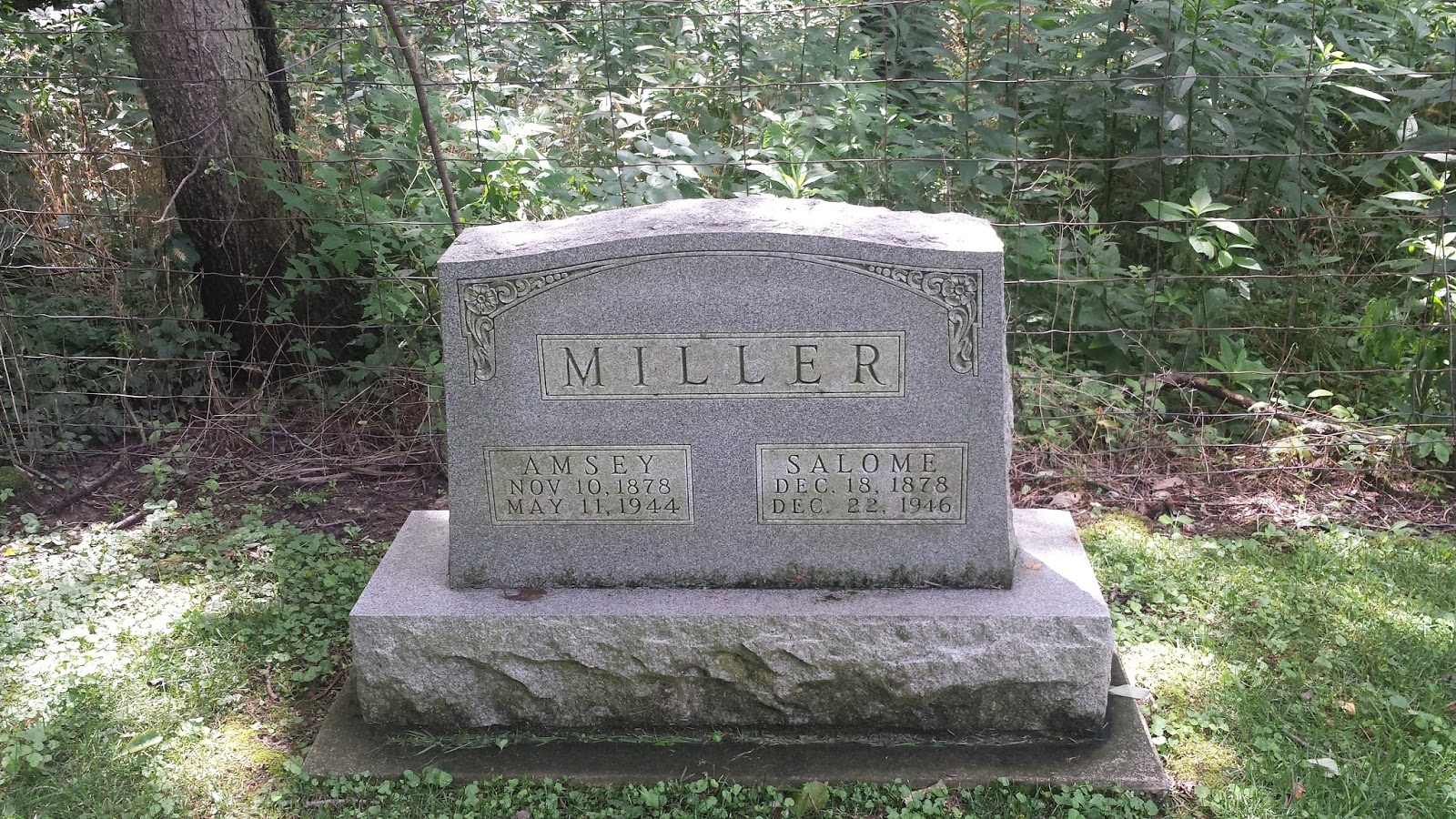
4. Salome (Wise) Miller (great grandmother)
  • Born 1878 in Carroll County, Indiana
  • Married Amsey Miller in 1900
  • They stayed with the Old German Baptist Brethren in 1919 when a group they call the "horse and buggy" brethren split off opposed to cars and electricity.
  • In 1912ish, moved from a brick house west of Camden to a house on the northwest corner of Camden itself.
  • Died in 1946 in Camden


Deer Creek Old German Baptist Brethren Church


5. Esther (Miller) Schenck (grandmother)
Dorsey and Esther Schenck, 1920
  • Born in 1902 in Carroll County
  • Married Dorsey Schenck in 1920 in her home in Camden
  • Got saved in a tent revival in Delphi and was Pilgrim Holiness until the merger that formed the Wesleyan Church in 1968.
  • Died in Indianapolis in 1977


6. Lee Schenck (father)

  • born in Thorntown, 1924
  • Married Helen Shepherd in 1947 in Frankfort
  • Pilgrim and Wesleyan
  • Passed in 2012
Dad, me, and son Tom

Friday, July 21, 2017

Adam and the Genome 7: Four Principles for Bible Reading

Chapter 5 begins the second set of chapters, by Scot McKnight in Dennis Venema and Scot McKnight's book, Adam and the Genome: Reading Scripture after Genetic Science.

Previous posts
Personal Preface
Forward and Introduction
1. Evolution as a Scientific Theory
2. Genomes as Language, Genomes as Books
3. Adam's Last Stand?
4. Intelligent Design?

Chapter 5
Chapter 5 is titled, "Adam, Eve, and the Genome: Four Principles for Reading the Bible after the Human Genome Project."

1. Scot begins the chapter with his own story, which is so similar to so many of us. Indeed, he mentions a student who came up to him after a lecture at North Park University and said, "Thank you. This lecture saved my faith" (104). I don't know if this claim is true, but McKnight claims that "The number one reason young Christians leave the faith is the conflict between science and faith, and that conflict can be narrowed to the conflict between evolutionary theory and human origins as traditionally read in Genesis 1-2" (104-15).

This brings me to a request for the majority of Christians who do not struggle with this issue or who have come to the conclusion that the science for creationism is clear cut. I dare say that we all have thoughts about God and the Bible that are wrong. How could we not? It is sobering to see the issues where Christians have vehemently said, "It's this way, no other," only for others to agree later that they were completely wrong.

I don't believe that our precise understandings save us. I don't believe the Bible teaches that our understanding saves us. We are saved on the basis of our faith in Jesus Christ. You will not find a verse that says we can only be saved if we have a particular understanding of the Bible or science. Rather "the one who comes to God must believe that he exists and rewards those who diligently seek him" (Heb. 11:6).

So Christians need to leave a space for other Christians who struggle on the questions of science or who have reached different conclusions on matters of science and faith. Souls are at stake. Woe to anyone who puts a stumblingblock before one of these little ones! Now that's actually something the Bible says, Jesus in fact.

2. Here are some quotes from the early part of the chapter:
  • "There is a better way, one that permits each of the disciplines to speak its own language but also requires each of the voices to speak to one another" (94).
  • A defining moment for Scot was asking himself the question "whether traditional interpretations of Genesis 1-2 were perhaps well intended but misguided and in need of rethinking" (95).
  • "Every statement about Adam and Eve in the Old Testament, in Jewish literature, and in the New Testament is made from a context and into a context" (97).
3. Scot sets out four principles in this discussion:

A. Respect - "To understand what someone is telling us, we must respect that person as a person" (98). In terms of Genesis 1-11, "we must respect that text as designed for the ancient Near Eastern culture" (99). "It is disrespectful to Genesis 1-11 to think it somehow should understand modern science, DNA, and the Human Genome Project, or for that matter the science of any generation after the writing down of Genesis 1-11!

"Genuine respect begins when we let Genesis 1-11 be Genesis 1-11, which means letting Genesis 1-11 be ancient Near Eastern and not modern Western science" (100).

B. Honesty - "Face the facts and do not fear the facts" (100). "Are you willing to face the facts--the facts of the Bible and the facts of science?"

McKnight makes the controversial claim that some of the most ardent defenders of certain interpretations of the Bible on these issues might actually be afraid. They are afraid to open the door to such questions because they are afraid it will lead them to lose their faith.

McKnight does not only ascribe this kind of uncharitable spirit to creationists but to some Christian evolutionists as well. He quotes Ron Osborn: "I have often been equally dismayed by the attitudes evinced by some individuals on the other side of the debate over creation and evolution... how quickly some are prepared to write off people of sincere faith who are at different places in their intellectual and spiritual journeys" (101).

C. Sensitivity to the Student of Science
I already mentioned the student whose faith McKnight says was saved by him opening up the window to the possibility of having faith and yet not concluding God created the universe 10,000 years ago. "The student is in my rearview mirror in all I have to say in my section of this book" (105).

D. Primacy of Scripture
Scot is an evangelical, so the Bible always comes first. The investigation of truth can go to other bodies of knowledge in addition to the Bible, but it always starts with the Bible: "Scripture first.'

4. He ends the chapter with a sense of some of the complexity these discussions can take on. For example, what do we mean by the "historical" Adam and Eve? Another view of Adam and Eve is the "archetypal view," Adam and Eve as representatives of all humanity. His sense of a "literary" view does not so much draw conclusions on the historical, but looks at them within the text of the Bible.

More to come...

Jamestown 4

continued from last week
__________________
On June 22, 1607, a little over a month after the group had settled on the peninsula of Jamestown, Captain Newport returned to England to get more supplies and to take back some pyrite that they thought was gold. Since they left behind one of the ships, The Discovery, John Smith took it upon himself to explore the area. He found it difficult to stay put in the settlement with someone else in charge whom he didn't particularly think knew what he was doing.

On three trips in The Discovery, John Smith mapped out the area. His maps of what we call Chesapeake Bay were to serve generations to come. On one of these mapping ventures, he had his famous encounter with Powhatan. This was the incident when he said Pocahontas plead for his life. Of course he never even mentioned this version of the story until some time later. Some think he embellished the story after the fact.

While exploring a small tributary in a canoe, he and two others came under attack. He was hit by an arrow in the leg, but the natives lowered their bows when he lowered his pistol. The other two men with him were killed, as were most of those back at his main ship.

For many days, he was their prisoner. First of one of the lower kings, Opechancanough, kept him. Smith amazed them with his compass and with tales of the universe. “The earth is the center of a number of concentric circles,” he told them, “with the sun on one, the moon on another, Venus on yet another.” Either Smith had not yet heard of Copernicus or he did not believe him. The glass covering of his compass fascinated Opechancanough. The native king could see the compass needle but could not touch it. Glass was unknown to the native Americans.

On another occasion, Smith convinced them to send two natives with a notepad back to James Towne. The message was that he was being well treated and they should not launch any attacks. When the messengers returned with the things Smith had written down, Openchancanough was amazed, since he did not understand how writing worked.

Eventually, Smith was able to meet the great king of the Powhatan nation, Powhatan himself. Before then, he was taken from one group to the next, one house to the next. They were showing him off to the whole nation, bit by bit.

Powhatan, whose actual name was Wahunsunacock, treated Smith with honor. When asked why the English had come, Smith created an elaborate lie about fleeing the Spanish and the settlement only being temporary.

It was on this occasion that he said they seized him and took him to a rock, as if they were going to bash his head repeatedly into it. It was at this point that Pocahontas was said to rush over and put his head in her hands, putting her cheek against his, pleading for mercy from her father.

So Powhatan spared him and made him a chief. Some think the event might have been some sort of ritual.

For the next few months, the settlement had more and more direct interaction with the Native Americans. Every few days, Pocahontas would bring supplies to the fort. Sometimes the English and the natives got along well. At other times it was rough.

Neither trusted the other. From time to time one side would seize a couple people from the other. Then they would negotiate their return. The natives seemed to respect Smith the most.

Captain Christopher Newport returned with the First Supply on January 8, 1608 and brought 120 more people to add to the mere 38 who had survived the winter. When he arrived, he found that the fort had just burned to the ground...