Showing posts with label general relativity. Show all posts

Tuesday, September 09, 2025

3.1 Creation and the Big Bang -- Relativity

Back in the summer I wrote a little with a few to the Science and Scripture class I designed and have occasionally taught for Houghton University. This week I'd like to work a bit on Chapter 3 of a book proposal I'd soon like to submit somewhere. Chapter 3 is "Creation and the Big Bang."

Previous writings here on the blog have included:

2.1 Relationships between Science and Faith
2.2 Critical Realism and the Coherence of Truth
2.3 Approaches to Scripture
8.1 Approaches to Genesis 2-3
8.2 Situating Genesis 2-3
______________________________
3.1 General and Special Relativity
In 1905, a young patent clerk named Albert Einstein submitted a paper trying to resolve one of the unresolved conundrums of physics at that time. Experiments had shown that the speed of light remained constant no matter how fast or slow the source of the light was moving. This was baffling because it was not how other waves behaved. Scientists expected the speed of light to add to or subtract from the motion of its source, like a train’s headlight shining forward or backward. Yet every test showed that light’s speed never changed. 

Before Einstein, physicists expected light to behave like a projectile. If you shine a flashlight from the front of a moving train, its speed should be the train’s speed plus the speed of light. If you shine it backward, it should be the speed of light minus the train’s speed. But experiments had already shown that no matter how fast the train—or the Earth itself—was moving, the speed of light remained the same. This contradiction is what Einstein set out to resolve in 1905.

Einstein’s proposed solution was that space and time actually appeared to be longer or shorter depending on how something was moving in relation to you. If you were on the ground looking at a spaceship moving quickly in the sky, the length of the spaceship would be shorter to you than if it were sitting next to you (called “length contraction”). Similarly, a clock on the spaceship would move more slowly to you than a clock next to you (called “time dilation”). Mind you, if you were on the spaceship, space and time would appear normally. But they would appear differently to you if you were observing from a framework moving more slowly in relation to the spaceship.

This proposal came to be known as the theory of special relativity. Einstein proposed that space and time were not separate aspects of a particular context or framework. Instead, they were intimately connected to each other – later conceptualized as "spacetime." As an object approached the speed of light, its length in the direction of motion contracted from the standpoint of something moving much more slowly, and time appeared to slow down for it.

The mathematical equation for the contraction of length as something approaches the speed of light is known as the Lorentz contraction formula. Here is the formula.
_____________________
Textbox:

L=L0​ * sqrt (1−v^2/c^2​​)

Where:
L = Observed length of the moving object (contracted length)
L0​ = Proper length (length of the object at rest)
v = Velocity of the object relative to the observer
c = Speed of light (≈3.00×10^8 m/s)
_____________________

You can see that when something is moving much more slowly than the speed of light, there will be almost no observable difference in length. When the velocity is small, v is much smaller than c, making that part approach 0. The length equals the length proper. But as an object approaches the speed of light, the difference in length becomes very significant. The length of the object approaches zero.

In Einstein’s theory of special relativity, the speed of light becomes the universal speed limit. No object with mass can reach or exceed the speed of light, and the speed of light will be the same no matter how quickly or slowly an object is moving. This idea was counterintuitive. If you stood on top of a train and threw a rock forward, you would expect the speed of the rock from the standpoint of the ground to be the speed of the train plus the speed of the rock. In everyday life, speeds add up or subtract. But if you shine a flashlight forward or backward from the top of a train, the speed of light will measure exactly the same either way. It’s the space and time that changes relative to the ground.

In 1915, Einstein extended his theory to propose the general theory of relativity. The key new element was the impact of mass on spacetime. What Einstein proposed was that mass and energy curve spacetime. When light travels near a sun, it appears to curve because the mass is curving spacetime. This was confirmed in 1919 when Arthur Eddington observed that starlight was displaced passing near the Sun. The curvature of spacetime was altering the light coming past the Sun.

The conclusion, in effect, is that space and time are not rigid but can stretch, curve, and expand. Indeed, it would be confirmed in 1929 by Edwin Hubble that space is expanding. This is not just about the matter in the universe expanding, but the fabric of space itself is getting bigger. The current model sees the universe beginning with a point and then rapidly expanding into the vast universe we know today.

We will ponder these discoveries in relation to creation later in the chapter. It changes our view of creation from one where God puts materials into emptiness to one where God creates the emptiness itself. It may transform our sense of what a creation out of nothing (ex nihilo in Latin) might mean. Apparently, God did not create the universe out of zero but out of an empty set with no elements in it at all.

Friday, August 03, 2018

Friday Science: The Euclidean metric (1.14.1a)

About every other Friday I want to move through another section of Peter Collier's A Most Incomprehensible Thing: Notes Toward a Very Gentle Introduction to the Mathematics of Relativity.

Here is my first post in this series.

1. The brilliant idea of Collier's book, one to which I have long subscribed, is that theory is most effectively learned on a "need to know" basis. There are many gifted "abstracticians" among us who do not need an answer to the question, "What do I need to know this for? When am I ever going to use this?" Indeed, I was one of them in high school and college. I still affirm those who are wired this way. Go for it!

But if the goal is actual learning, most of us best learn theory as we are engaged in practice. This was the guiding principle of Phase 1 of Wesley Seminary at Indiana Wesleyan University, of which I was a co-founder. Indeed, philosophically, I have adopted the epistemological stance of a pragmatist/nominalist. That is to say, the abstraction of theory in fact reduces to a useful game humans play in order to operate more effectively in the concrete world of realia. In other words, ideas are useful abstractions of reality.

I thus mock those who say, "You need to know the theory in order to do the practice effectively." Poppycock! The theory is abstracted from effective practice. Since I operate in the world of academia, you can imagine how often I whisper, "Numbnuts" under my breath. The number of virtual Platonists around me is a constant source of frustration.

2. So my previous post was in 4.1 of Collier's book, introducing the curvature of space. Section 2 moves on to Riemannian manifolds and "the metric." But to understand the "metric" of general relativity, Collier reaches back into the metric of special relativity (3.5), which reaches back into the Euclidean metric (1.14.1). So if I am to follow my principle of "theory on a need to know basis," I must now post on the Euclidean metric. Then in two weeks time, the Minkowski metric of general relativity (3.5).

The Euclidean metric
3. In high school geometry, we basically learned "Euclidean" geometry, named after the ancient Greek mathematician. So when we refer to Euclidean space, we mean the way space would behave if it were exactly like what we learned in high school.

In three dimensional Euclidean space, the Pythagorean theorem applies: l2 = a2 + b2 + c2.

Don't let the expanded form mess you up. For three dimensions, we've just added an extra square. We've used L for the hypotenuse for "line," meaning the "line" that results from these three components.

4. When we begin to talk about space in advanced physics, we have to make some modifications. For one, we begin to talk about incredibly small increments of space. In calculus (which I won't review here), we talk about "infinitesimals," meaning almost infinitely small increments.

So when we talk about dx or dy or dz we are talking about almost infinitely small increments on the x axis or y axis or z axis. These are called coordinate differentials. So now we might say that

dl2 = dx2 + dy2 + dz2

We can call this version of L the line element, a really small increment of the line that results from these components (the "resultant).

5. Now I'm no fan of matrices. But they are all over relativity and quantum mechanics. I don't know why they work and this frustrates me because 2018 Ken is not 1984 Ken. So here I will simply suspend my questions and present the "game" of matrices as it relates here.

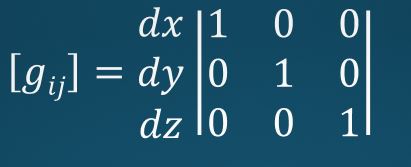
A metric or metric tensor is a matrix that presents the coefficients of the differential equation above.


So the first 1 in the top left reflects that there is a 1 in front of dx2. The second one in the middle reflects that there is a 1 in front of the dy2. The third 1 in the bottom right indicates that there is a 1 in front of the dz2.

"Ours is not to question why. Ours is just to memorize or die."

gij (which should be in brackets, sorry) is a way of referring to a matrix. The matrix is g, and the elements of the matrix are in i rows and j columns. So the dy component is in the position 2, 2 (row 2, column 2).

6. To explain the lay out a little more, think of it this way:

                       dx    dy    dz


Here you can see that the first 1 is in the cross of dx, etc.


7. Collier goes on to formulate this matrix in terms of polar coordinates, but I don't need them to understand the matrices of general relativity yet, so I'm going to pass for the moment.

Saturday, July 14, 2018

Friday Science: General Relativity 1

A little over four years ago, I found a great book on relativity. Peter Collier's A Most Incomprehensible Thing: Notes Toward a Very Gentle Introduction to the Mathematics of Relativity. I've gone through a little less than half of it.

His concept is to introduce all the math needed for special and general relativity in the first 100 pages or so. He tries not to assume that you've had any of the math beyond algebra. He does pretty well although I think you probably need to have done some of it before to get it.

BTW, I first saw an approach something like this in the summer of 1983 at Rose-Hulman. I was given a physics textbook by Marion and Hornyak that interspersed calculus lessons with the physics. I thought it was brilliant--introduce the background math as you need it. It's something like problem-based learning.

I've basically finished Hawking. So on Fridays I hope more or less to alternate between Susskind's book on quantum mechanics and Collier. I don't entirely have down everything from his 58 pages on special relativity. Maybe I'll go back at some point. But I want to move forward through his 180 or so pages on general relativity.

4.1 Introducing the Manifold
a. Special relativity functions on the basis of what is called "Minkowski" space, which is flat.
  • 3.2.2 Time for a flashback. In chapter 3, he introduces Minkowski space or spacetime. In Newtonian mechanics, we talk about three-dimensional space, Euclidean space. 
  • For special relativity, Einstein drew on the idea of four-dimensional space, with time as the fourth dimension (spacetime). 
  • This is named for the German mathematician, Hermann Minkowski (1864-1909).
  • In Minkowski space, parallel lines never meet, so it is still flat space.
In general relativity, space curves, so we need some new math. Einstein, with the help of David Hilbert, found this math in the work of the German Bernhard Reimann (1826-66).
b. In general relativity, matter and energy curve spacetime. Gravity is not considered a force but a property of the curvature of spacetime. The idea of a "Riemannian manifold" is used to model this. A manifold is a smoothly curved space that is locally flat.

It would be like an ant walking on an apple. The ant thinks it is walking straight, but it is curving around the apple. Such a path on a sphere or curved surface is called a geodesic.

A circle is a one-dimensional manifold. If you walk on the perimeter and the circle is large enough, it just seems like you are walking straight. A sphere is a two-dimensional manifold. We can speak of a manifold as n-dimensional when locally it can be described by n dimensions.